Free Crane Inspection Log Template
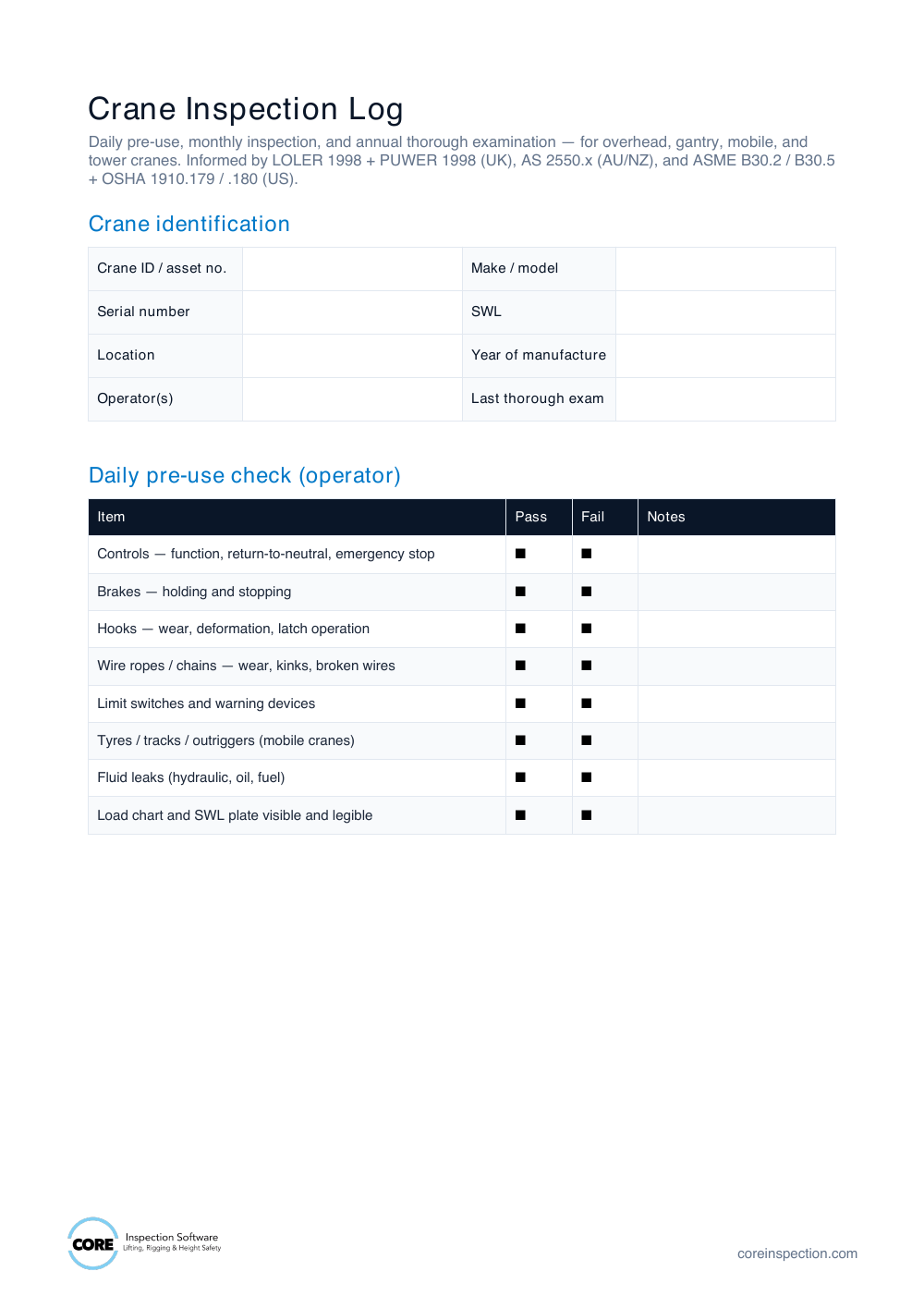
A complete crane inspection log covering daily pre-use checks, monthly inspections, and annual thorough examinations. Works for overhead, gantry, mobile, and tower cranes, informed by LOLER + PUWER (UK), AS 2550 (AU/NZ), and ASME B30.2 / B30.5 + OSHA (US). Editable in PDF and Excel.
Download Free Crane Inspection Log
Enter your details below to get instant access.
What's in the log
Three layered inspection sheets in one document, built around real LOLER and OHS-style crane inspection requirements. Edit your branding once and use across your fleet.
- Daily pre-use check sheet (controls, brakes, hooks, ropes/chains)
- Monthly inspection (mechanical, structural, electrical)
- Annual thorough examination summary
- Crane identification: serial, location, SWL, manufacturer
- Inspector name, signature, and date
- Defect log with severity and corrective action
- Out-of-service sticker / lock-out reference field
- Hours / cycles tracking
- Conditional formatting for due dates
Who uses this log
Anyone responsible for the safe operation, inspection, or maintenance of cranes.
Crane operators
Daily pre-use checks captured consistently across shifts and sites.
Maintenance teams
Monthly inspections rolled into preventative maintenance schedules.
Crane inspection companies
Standardised log to issue with annual thorough examinations.
Construction site supervisors
Site lift teams documenting compliance for principal contractors.
Standards this log is informed by
Crane inspection is statutory in most jurisdictions. The log captures what each region's framework expects.
United Kingdom: LOLER 1998 + PUWER 1998
LOLER 1998 requires that all lifting equipment, including cranes, is subject to thorough examination by a competent person at statutory intervals. Schedule 1 specifies what the resulting Report of Thorough Examination must contain. PUWER 1998 applies on top because cranes are also work equipment. Reg 5 requires maintenance, and Reg 6 requires inspection where safety depends on installation conditions or where exposure causes deterioration liable to result in dangerous situations. Both are HSE-enforced.
- 12-month thorough examination for typical-use cranes
- 6-month thorough examination if used to lift persons
- Additional examination after exceptional loading or modification
- PUWER Reg 5 maintenance; Reg 6 inspection where installation or deterioration risks apply
- LOLER Schedule 1 specifies the report format
Australia / NZ: AS 2550, AS 1418, NATA
AS 2550.x is the Australian/NZ multi-part standard for safe use of cranes, hoists and winches. AS 2550.1 is general; .3 covers bridge and gantry cranes, .5 mobile, .10 MEWPs (current 2025 update), .11 vehicle-loading. AS 1418.x covers design. AS 2550 also requires a major inspection at design-life thresholds (commonly 10y mechanical, 25y structural, or after two-thirds of design life) and recommissioning of older cranes. Annual third-party inspections by a competent person, frequently NATA-accredited (ISO/IEC 17020), are standard practice.
- AS 2550.1: general safe-use requirements
- AS 2550.3 / .5 / .10 / .11: equipment-specific
- AS 1418.x: crane design (multi-part)
- Major inspection at design-life thresholds
- NATA-accredited inspection bodies widely used
United States: ASME B30 + OSHA
The ASME B30 family is the US safety-standard backbone. B30.2 covers overhead and gantry cranes; B30.3 tower cranes; B30.5 mobile and locomotive cranes. B30.10 covers crane hooks (with specific inspection criteria: throat opening ≤5% of original, no cracks/deformation). OSHA 1910.179 (overhead/gantry) and 1910.180 (mobile, general industry) plus 29 CFR 1926.1400-1442 (cranes in construction) are the federal regulations sitting on top.
- ASME B30.2: overhead and gantry cranes
- ASME B30.3: tower cranes
- ASME B30.5: mobile cranes
- ASME B30.10: hooks (specific inspection criteria)
- OSHA 1910.179 / .180: federal regulation (general industry)
- OSHA 29 CFR 1926.1400-1442: cranes in construction
Typical crane inspection intervals
Statutory minimums. Operating environment, duty cycle and manufacturer guidance can require more frequent checks. AU/NZ also has major-inspection thresholds (see Standards Reference inside the template).
| Crane type / activity | Minimum frequency | Notes |
|---|---|---|
| Daily pre-use check (operator) | Every shift | Controls, brakes, hooks, ropes, alarms, limits |
| Routine inspection (maintenance) | Monthly | Walk-through, lubrication, fastener and structural checks |
| Thorough examination — typical use | 12 months | Competent person, written report (LOLER Schedule 1) |
| Thorough examination — lifting persons | 6 months | MEWPs, suspended access, passenger lifts |
| Major inspection (AU/NZ — AS 2550) | Design-life thresholds | Commonly 10y mechanical / 25y structural / two-thirds of design life |
Frequently asked questions
An inspection is generally a routine check (daily pre-use, weekly, or monthly walk-arounds) to identify obvious defects. A thorough examination (LOLER terminology) is a formal, structured examination by a competent person, with a written report. In the US the equivalent is a periodic inspection under ASME B30 + OSHA. In AU/NZ it's the annual third-party inspection under AS 2550. The log gives you sheets for all three layers.
Related resources
More free templates and resources for inspection professionals.
Still managing inspections on paper?
Core Inspection software helps lifting equipment companies reduce admin time by 40-60%. Generate professional certificates, manage equipment registers, and automate scheduling, all in one platform.
Trusted by inspection companies serving 150,000+ organisations worldwide