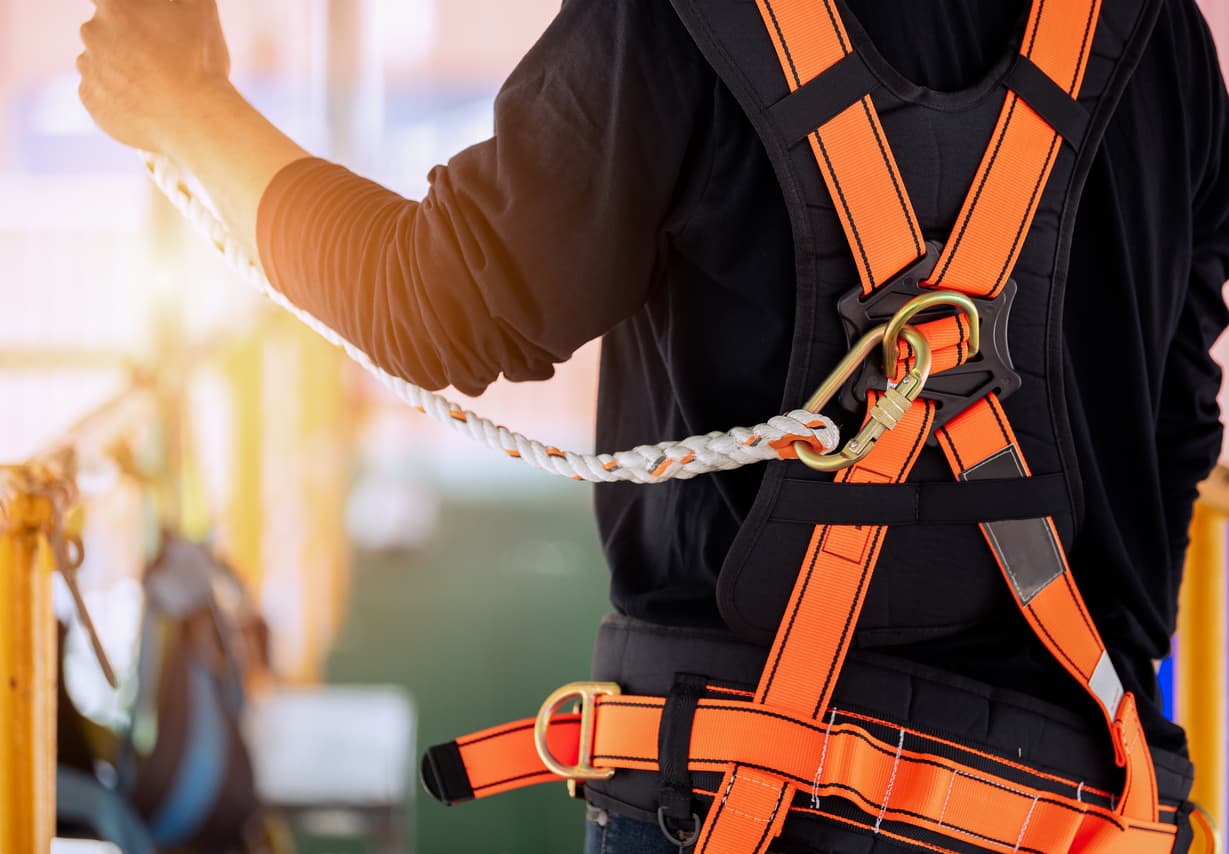
Height Safety and PPE Inspection Software
Harnesses, lanyards, self-retracting lifelines, and anchor points: pre-use checks, six-monthly and annual inspections, retirement rules, and certificates for every customer site you service.

Overview
Height safety gear fails quietly: webbing wear, a pulled stitch, a harness past its manufacturer's lifespan, an anchor nobody has load-tested since installation. Core keeps a serialised register of every harness, lanyard, and anchor across your customers' sites, schedules the six-monthly and annual inspections each standard sets, quarantines an item the moment it fails, and issues the certificate pack on approval. In the field, technicians scan the tag and see the item's full history before they touch it.
- Mobile apps for iOS and Android
- Works offline in the field
- Professional PDF certificates
- Customer portal access
What it does
Forms, scheduling, certificates, and the customer portal, in one system.
All Height Safety Equipment
Full body harnesses, lanyards, energy absorbers, self-retracting lifelines, rope access kit, anchor points, horizontal lifelines, and rescue and descent devices.
Tag Scanning
Every item carries a serial, barcode, QR code, or RFID tag. One scan opens its inspection history, the standard it works under, and its next-due date.
Inspection Scheduling
Pre-use, six-monthly, and annual inspections per item and per standard, whether EN 365, AS/NZS 1891.4:2025, or ANSI/ASSP Z359.2, with overdue alerts to your team and the customer.
Retirement and Quarantine
A fall arrest event, a failed inspection, or the manufacturer's lifespan takes the item out of service, and it can't pass again until a competent person reviews it.
Compliance Dashboard
Compliance status across every customer's height safety equipment, by site and by equipment type.
Certificates and Registers
Inspection certificates and site registers from your own DOCX templates, carrying your branding and the inspector's competency details.
Expiry Notifications
Alerts before an item reaches the end of its service life or its inspection due date.
Customer Portal
Equipment owners log in to their register, certificates, and quarantined items, under your branding.
What height safety inspection software has to do
A harness has two inspection regimes running at once. The wearer checks it before every use. A competent person inspects it on a fixed interval, six-monthly in the UK and Australia, annual in the US, and signs a record. On top of that sit the retirement rules: a fall arrest event, a failed inspection, or a manufacturer's lifespan date ends the item's service life no matter its condition. Height safety inspection software keeps the intervals, enforces the retirement rules, and produces the record each standard asks for.
For a company that inspects other people's height safety equipment, the job is wider. The register spans hundreds of customer sites, each with its own racks of harnesses, its own installed anchors, and its own regime. Each customer wants to see their own equipment and their own certificates. Technicians hold different competencies, and an inspection that needs a competent person can't go to someone who isn't one. Core is built for that business: scheduling, field inspection, certificates, client portals, and the billing handoff in one system.
Inspection regimes by standard
Each item in Core carries the inspection regime of the rule it works under, with its own due dates and the record that rule requires.
| Standard | Applies to | Inspections Core schedules | Record produced |
|---|---|---|---|
| OSHA 29 CFR 1910.140 and 1926.502 | Personal fall protection systems, general industry and construction (US) | Inspection by the user before initial use each shift (1910.140) and before each use (1926.502); any system subjected to impact loading is removed from service until a competent person inspects it | Defective components removed from service; Core logs the pre-use result and the removal |
| ANSI/ASSP Z359.2-2023 | Managed fall protection programs (US) | Formal inspection by a competent person other than the user at intervals not exceeding one year, or more often where the manufacturer requires it | Dated inspection record per item carrying the competent person's identity |
| Work at Height Regulations 2005, HSE INDG367, EN 365 | Fall arrest equipment made from webbing or rope (UK) | Pre-use checks by the user; detailed inspections by a competent person at least every six months, every three months in arduous conditions; interim inspections where the risk assessment calls for them; EN 365 periodic examination at least every 12 months | A record of each detailed inspection, kept until the next one |
| AS/NZS 1891.4:2025, removable equipment | Harnesses, lanyards, and other PPE for work at height (AU/NZ) | User inspection before each use; recorded inspection by a competent inspector every six months | Inspection record per item with the inspector's qualification, and the NATA accreditation number where the inspection body holds one |
| AS/NZS 1891.4:2025, installed systems | Installed fall arrest systems, anchor points, horizontal lifelines (AU/NZ) | Annual inspection, with the earlier allowance of up to five years on a manufacturer's say-so removed; annual proof loading of fixed multi-fastener anchors can be replaced by the documented installation, calculation, specification, and proof-load records | Annual inspection record plus the four anchor documents held against the asset |
From work order to certificate
One job carries the schedule, the inspection, the certificate, and the invoice line.
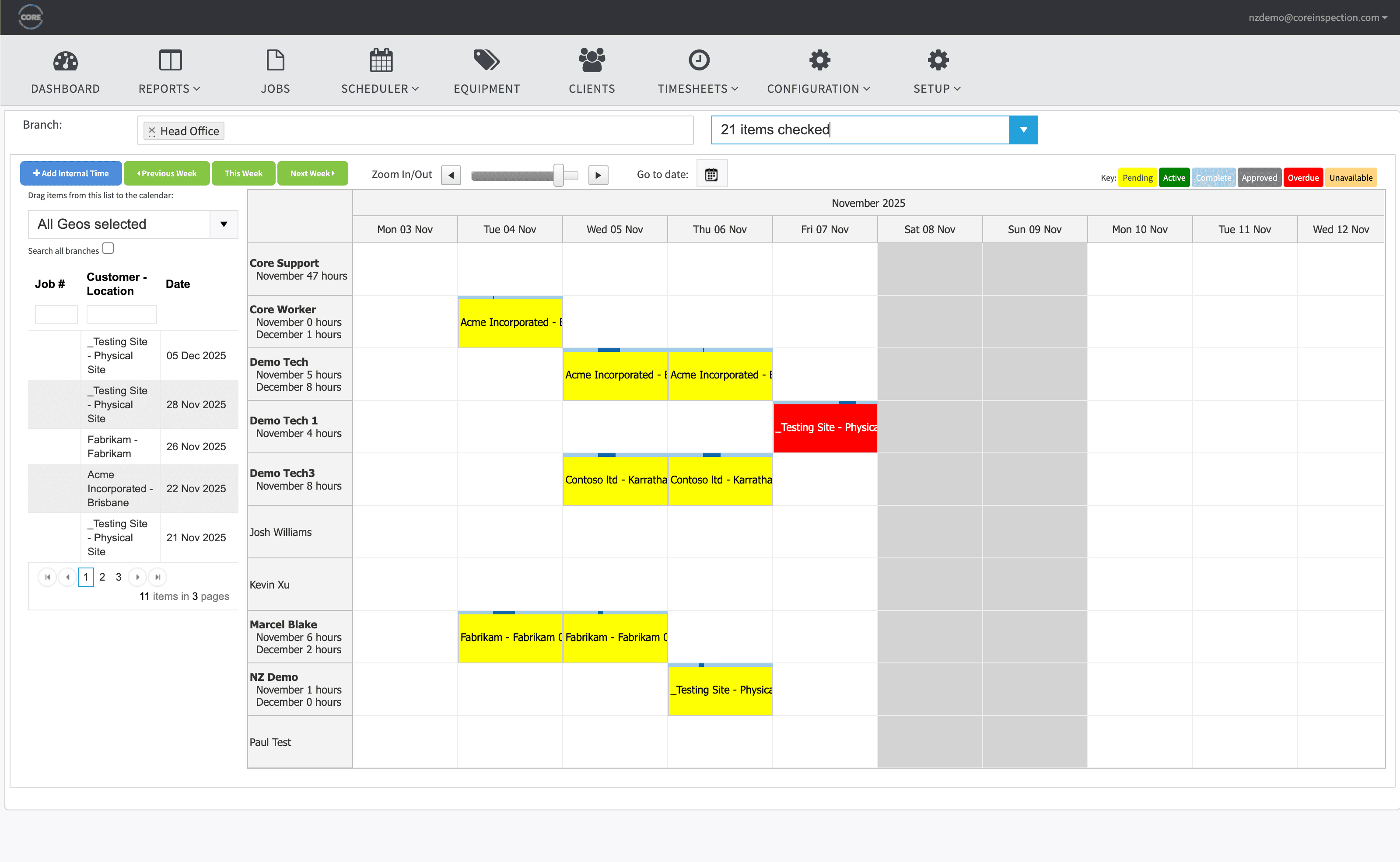
- 1
Schedule against competency
Jobs go on a drag-and-drop calendar. Core holds each technician's competencies, so a six-monthly inspection that needs a competent person under AS/NZS 1891.4 or Z359.2 can't be booked to someone without the record.
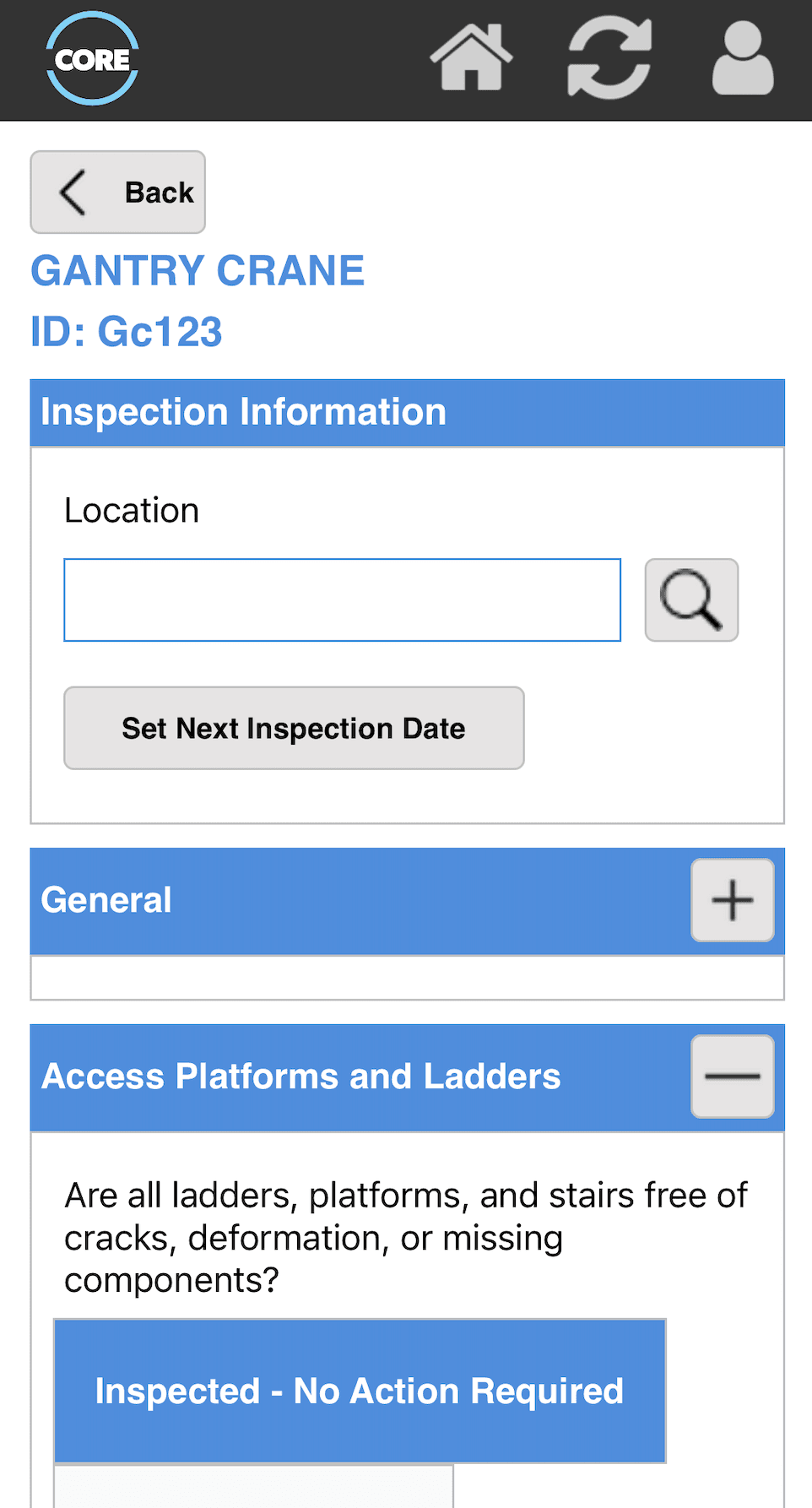
- 2
Inspect in the field
Native iOS and Android apps work fully offline. Technicians scan the item's tag, run the checklist for that equipment type, photograph defects, and record pass, fail, or quarantine on the device.
- 3
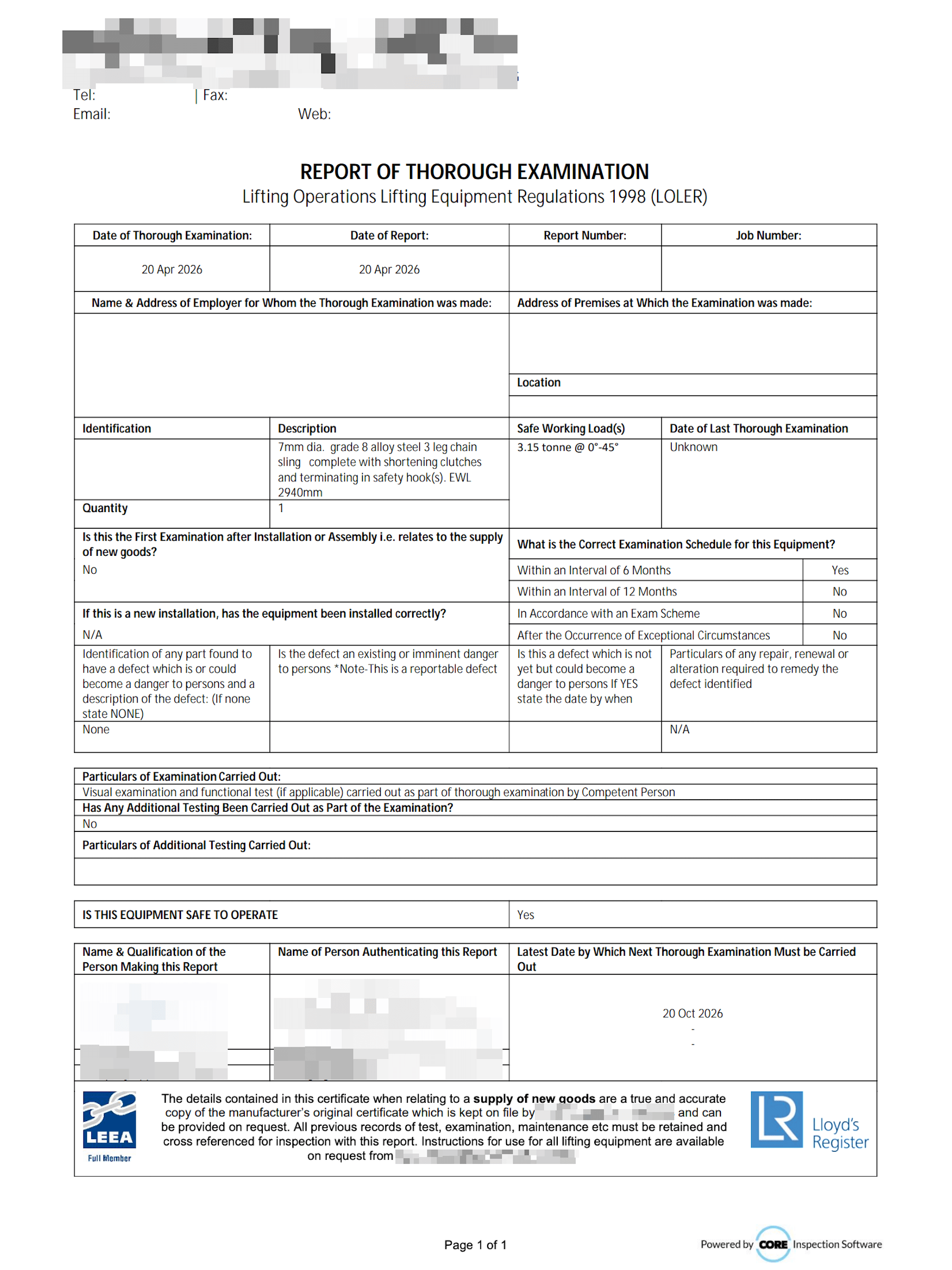
Approve and issue
Results pass through your approval stages, then render into your own DOCX template as a harness inspection certificate, an anchor point certification, or a full site register.
- 4
Deliver and bill
Certificates reach the customer's portal as one PDF pack per visit, and the results roll into a per-customer billing summary for your invoicing run.
Three retirement rules, enforced at the point of record
A harness that should be out of service stays out of service, on every site, on every visit.
A fall arrest event
OSHA removes any system subjected to impact loading from service until a competent person has inspected it (29 CFR 1926.502(d)(19)), and EN 365 and AS/NZS 1891.4 carry the same rule. In Core, recording a fall arrest event quarantines the item on the spot, and it will not pass a pre-use check until that review is logged.
A failed inspection
An item that fails, or shows a defect outside the manufacturer's criteria, is quarantined. EN 365 requires that equipment withdrawn from use is not returned without a competent person's authorisation. Core blocks the item from passing again until that authorisation is recorded against it.
The manufacturer's lifespan
Each manufacturer sets a maximum service life, typically five to ten years from first use or from manufacture, and EN 365, AS/NZS 1891.4:2025, and ANSI/ASSP Z359.11 all defer to it. Core calculates the retirement date from the dates on the register and retires the item on the day, whether or not it shows wear.
Two inspections, two people, one record
Pre-use checks belong to the wearer. OSHA, EN 365, and AS/NZS 1891.4 all put the before-use inspection on the person about to clip in. The recorded inspection by a competent person is the service your business sells. Core holds both on the same asset. The customer's workers scan the tag and run a short pre-use check on their phone. Your technician runs the six-monthly or annual inspection on the visit. Both appear in the item's history and in the customer's portal, so when a harness is quarantined on a Tuesday pre-use check, your scheduler sees it before Thursday's visit.
Anchor points and installed systems follow the same pattern with a longer clock. The annual inspection under AS/NZS 1891.4:2025, the proof-load or documentation path for each anchor, and the installation records all sit against the anchor on the customer's site plan, so the recert visit starts with the paperwork already in hand.
A rack of harnesses in one visit
A height safety visit is rarely one harness. It is forty harnesses in a rack, their lanyards, the self-retracting lifelines on the tower, and the anchors on the roof. Multi-inspect captures the lot as one batch. The technician enters the shared details once, passes conforming items in bulk, opens only the ones with defects to photograph them, and issues one certificate pack for the whole visit.
Run a harness inspection in the interactive demoHow Core compares
Where each option fits, including the ones that fit better than Core.
Paper and spreadsheets
A register spreadsheet works for one site. It stops working when retirement dates depend on dates of first use across hundreds of customers, and a quarantined harness has to stay quarantined on a site you are not standing on.
See the full feature listPapertrail
Built for equipment owners inspecting their own PPE: climbing centres, rope access teams, wind farm operators. Core is built for the inspection company that services many customers, with scheduling, competency rules, batch inspection, and a portal per client.
Core vs PapertrailGeneral inspection apps
SafetyCulture and similar apps suit owner-operators running their own checklists. Core is built for companies whose business is inspecting and certifying equipment for customers.
Core vs SafetyCultureHeight safety inspection guides and templates
The standards behind the software, and free checklists and registers you can use today.
“Admin constraints eliminated. Business expansion fueled by operational efficiency.”
Beau Barlow, Director, All About Lifting & Safety
Read the All About Lifting & Safety case studyCompliance Standards We Support
Core's forms, certificates, and approval flows are built around the regimes you work to: LOLER, AS/NZS, ASME and OSHA.
- Work at Height Regulations 2005 and PUWER 1998, with HSE guidance INDG367 on inspecting fall arrest equipment, UK
- BS 8437 (Code of Practice for Selection, Use and Maintenance of Personal Fall Protection Systems), UK
- EN 365 (Personal Fall Protection Equipment: General Requirements), with EN 361, EN 354/355, EN 360, EN 362, and EN 795 for the equipment itself
- AS/NZS 1891 series (Personal Equipment for Work at Height), including AS/NZS 1891.4:2025, Australia and New Zealand
- OSHA 29 CFR 1910.140 (Personal Fall Protection Systems, General Industry), USA
- OSHA 29 CFR 1926 Subpart M (Fall Protection, Construction), USA
- ANSI/ASSP Z359 (Fall Protection Code), including Z359.2-2023 managed fall protection programs, USA
Frequently Asked Questions
What is height safety inspection software?
Height safety inspection software, called PPE inspection software in the UK and fall protection inspection software in the US, holds a serialised register of harnesses, lanyards, self-retracting lifelines, and anchor points, schedules each item's inspections at the interval its standard sets, captures the inspection on a phone, applies the retirement rules, and produces the certificate. For an inspection company it also carries the service side: jobs across many customer sites, technician competencies, a portal for each customer, and a billing handoff.
How often must a safety harness be inspected?
Before every use by the wearer, under OSHA 1910.140 and 1926.502, EN 365, and AS/NZS 1891.4 alike. On top of that comes a recorded inspection by a competent person. In the UK, HSE guidance INDG367 sets a detailed inspection at least every six months, and every three months in arduous conditions, with the EN 365 periodic examination at least every 12 months. In Australia and New Zealand, AS/NZS 1891.4:2025 keeps six-monthly inspections for harnesses, lanyards, and other removable items. In the US, ANSI/ASSP Z359.2 requires a competent person other than the user to inspect at intervals not exceeding one year. Core schedules each item to the regime its customer works under.
What does OSHA require for fall protection equipment inspection?
29 CFR 1926.502(d)(21) requires personal fall arrest systems to be inspected before each use for wear, damage, and other deterioration, with defective components removed from service. 29 CFR 1910.140(c)(18) requires the same inspection before initial use during each work shift in general industry. A system subjected to impact loading comes out of service until a competent person has inspected it and found it suitable for reuse (1926.502(d)(19)). OSHA sets no fixed periodic interval; ANSI/ASSP Z359.2 fills that gap with a documented competent-person inspection at least annually, and that is the record Core produces.
How often do anchor points need to be inspected in Australia?
Annually, under AS/NZS 1891.4:2025, for installed fall arrest systems and anchors. The 2025 edition removed the earlier allowance for a manufacturer to permit up to five years between inspections. Annual proof loading of chemically or mechanically fixed anchors with multiple fasteners can be replaced by documentation: installation to the manufacturer's guidelines, structural adequacy calculations, current manufacturer specifications and warranty, and certification that the anchor was proof loaded at installation and maintained since. Core stores those documents against the anchor and schedules the annual inspection.
When must a harness be retired?
Immediately after a fall arrest event, whatever it looks like. On any cut, abrasion, melted webbing, chemical exposure, or broken stitching at a structural point. On any deformed, corroded, or damaged D-ring, buckle, or adjuster. When the labels are missing or illegible, since the item's identity and standard can no longer be verified. And on the manufacturer's stated lifespan, typically five to ten years from first use or manufacture, regardless of condition. Core applies each trigger at the point it is recorded, so a retired harness cannot be passed by mistake on the next visit.
Does LOLER apply to harnesses?
Not when a harness is used only for fall arrest. The UK inspection duty for fall arrest equipment sits under the Work at Height Regulations 2005 and PUWER, with HSE guidance INDG367 setting the practical inspection schedule. Where the same harness and rope system lifts or lowers a person, as in rope access or rescue, LOLER applies as well, with a thorough examination every six months. Core handles both regimes on the same asset, each with its own interval and report.
Can Core work with harness inspection tags?
Yes. Each item carries a serial, barcode, QR code, or RFID tag, and scanning it in the mobile app opens the item's record: the standard it is inspected to, the last inspection, the next-due date, and any quarantine. The physical tag stays on the item. The register is what tells you whether the tag is still valid.
Can my customers' workers do their own pre-use checks in Core?
Yes. Workers scan the tag on the gear, run a short guided pre-use check on their phone, offline if needed, and either pass it or quarantine it. Each check is logged with the user, the time, and the location against the same asset your technician inspects on the six-monthly or annual visit.
Can equipment owners see their own compliance status?
Yes. The customer portal gives equipment owners access to their equipment register, inspection certificates, upcoming due dates, and any flagged defects or quarantined items, under your branding.
Can I set different inspection frequencies for different equipment types?
Yes. Intervals are set per equipment type, per standard, and where needed per item: six-monthly harness inspections for an Australian customer, annual competent-person inspections for a US customer, and annual installed-system inspections for anchors, all on the same register.
Free templates & resources
Industry-standard templates and registers: free, editable, ready to brand.
Height Safety Register Template
Excel and PDF register for harnesses, lanyards, and anchors, with retirement triggers.
View resourceHarness Inspection Checklist
Point-by-point inspection checklist with retirement triggers, in PDF and Word.
View resourceFall Protection Inspection Software (US)
Core for US fall protection inspection companies, built around OSHA 1910.140, 1926.502, and ANSI/ASSP Z359.
View resourceExplore Other Industries
The same platform covers cranes, forklifts, lifting equipment, height safety, and internal inspection programs.
Ready to Get Started?
Book a personalised demo and see how Core runs your inspection workflow, from schedule to certificate.