Free Full Body Harness Inspection Checklist
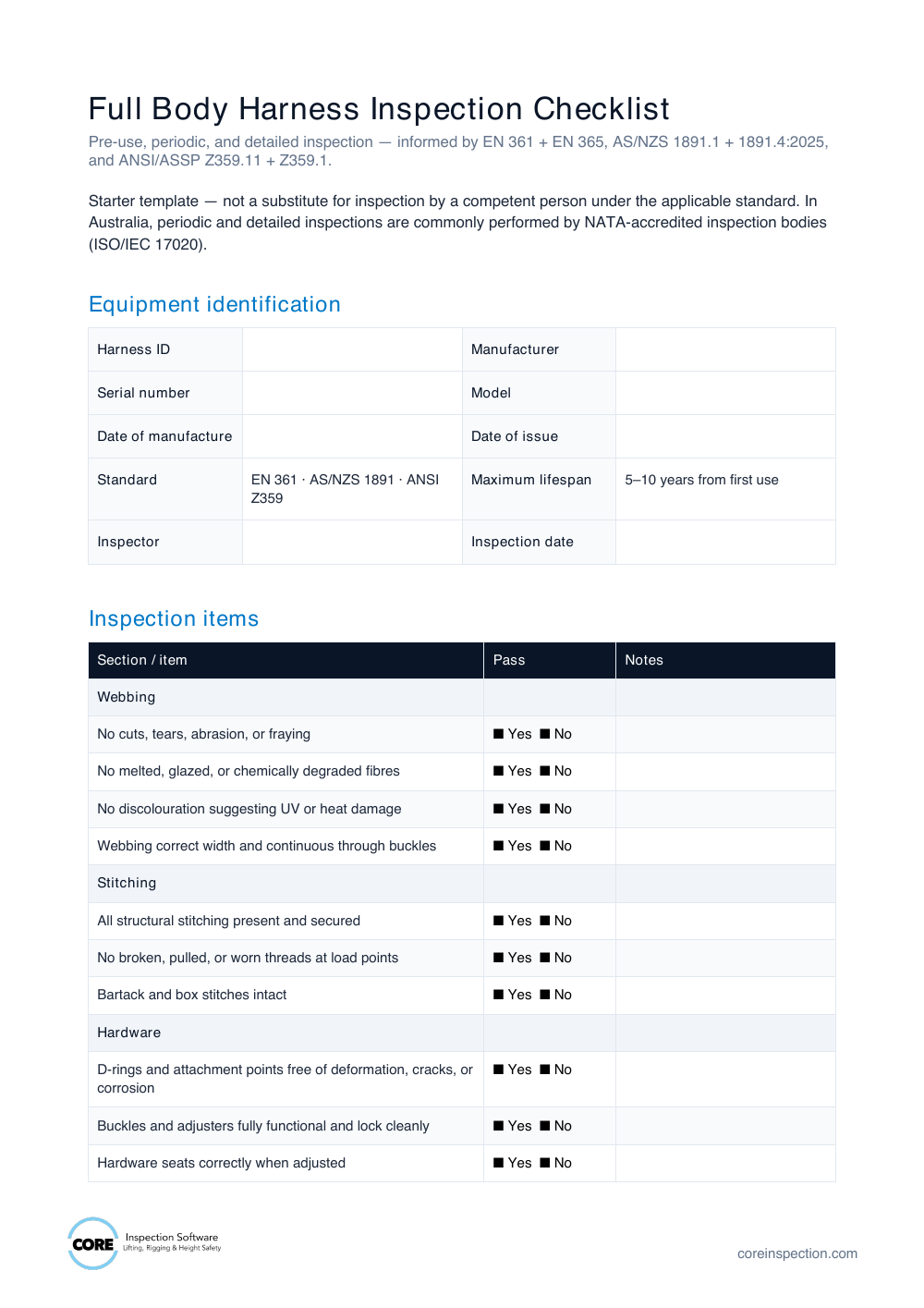
A point-by-point inspection checklist for full body harnesses. Webbing, stitching, hardware, labels, retirement triggers. Informed by EN 361 + EN 365 (UK/EU), AS/NZS 1891.1 + 1891.4:2025 (AU/NZ), and ANSI/ASSP Z359.11 + Z359.1 (US). Built for both pre-use and competent-person inspection.
Download Free Harness Inspection Checklist
Enter your details below to get instant access.
What's in the checklist
Covers every part of the harness, point by point. Use it for pre-use checks by the wearer or as a structured periodic inspection by a competent person.
- Harness ID, manufacturer, serial, date of manufacture
- Last inspection / next-due fields
- Webbing: abrasion, fraying, cuts, chemical exposure, UV
- Stitching: broken, loose, or pulled threads
- D-rings, buckles, adjusters: deformation, corrosion, function
- Lanyard attachment points and fall indicators
- Labels: present, legible, in-date
- Pass / Fail / Quarantine outcome
- Defect notes and inspector signature
- Retirement triggers reference card
Who uses this checklist
Anyone working at height, or anyone responsible for those who do.
Workers at height
Pre-use harness check before every use, every shift.
Competent persons
Periodic detailed inspection (typically 6 monthly) with documented results.
Site safety teams
Standardised checklist for site PPE issuance and retirement.
Training & assessment
Use as a teaching aid for new operators learning what 'good' looks like.
Standards this checklist is informed by
The inspection items and retirement triggers are common to EN, AS/NZS and ANSI/ASSP, so the checklist is one document you can use under any of them.
Europe / UK: EN 361 + EN 365
EN 365:2004 sets the general requirements for fall protection PPE. Periodic examination is by a competent person at intervals not exceeding 12 months, more often in intensive use or hazardous environments. The competent person must be knowledgeable of the manufacturer's current periodic-examination requirements. EN 361 specifies the harness itself. The UK statutory backstop is the Personal Protective Equipment at Work Regulations 1992 (as amended 2022); the primary statutory inspection driver for fall-arrest kit is the Work at Height Regulations 2005, with HSE INDG367 guidance.
- Periodic examination ≤ 12 months by competent person
- Detailed inspection records retained until next examination
- Manufacturer authorisation may be required for some equipment
Australia / NZ: AS/NZS 1891.4:2025 + NATA
AS/NZS 1891.4:2025 is the current standard for Selection, Use and Maintenance. It superseded the 2009 version and clarified periodic-inspection frequencies and competent-person requirements. AS/NZS 1891.1 covers harnesses themselves. In Australia, periodic and detailed inspections are commonly performed by NATA-accredited inspection bodies under ISO/IEC 17020.
- AS/NZS 1891.1: harness specification
- AS/NZS 1891.4:2025: selection, use, maintenance
- Pre-use, periodic (typically 6-monthly), detailed inspection
- NATA accreditation under ISO/IEC 17020 widely recognised
United States: ANSI/ASSP Z359
ANSI/ASSP Z359.1-2024 is the umbrella Fall Protection Code; ANSI/ASSP Z359.2-2023 establishes the managed fall-protection program and the role of the Competent Person. Z359.11-2021 specifies full body harnesses. Z359.13 covers personal energy absorbers and lanyards. OSHA 1910.140 (general industry) and 1926.502 (construction) are the federal regulations that sit on top.
- ANSI/ASSP Z359.1-2024: umbrella Fall Protection Code
- Z359.2-2023: managed fall protection program + Competent Person
- Z359.11: full body harness specification
- Z359.13: energy absorbers and lanyards
- OSHA 1910.140 / 1926.502: federal regulation
When to retire a harness immediately
These triggers are universal across EN 365, AS/NZS 1891.4 and ANSI Z359. If any are true, take the harness out of service without exercising judgement:
- Subject to a fall arrest event (regardless of visual condition)
- Cuts, abrasion, melted webbing, or chemical exposure
- Broken or pulled stitching at structural points
- Deformed, corroded, or damaged hardware (D-rings, buckles)
- Manufacturer's stated lifespan exceeded (typically 5–10 years from first use)
- Labels missing or illegible (cannot verify identity / standard)
Frequently asked questions
A pre-use check is required by the user every time the harness is donned. EN 365 specifies a periodic examination by a competent person at intervals not exceeding 12 months (more often in intensive or hazardous use). AS/NZS 1891.4:2025 commonly requires 6-monthly periodic inspection by a competent person plus annual detailed inspection. ANSI/ASSP Z359 expects similar layering. The checklist gives you a single document for all three layers.
Related resources
More free templates and resources for inspection professionals.
Still managing inspections on paper?
Core Inspection software helps lifting equipment companies reduce admin time by 40-60%. Generate professional certificates, manage equipment registers, and automate scheduling, all in one platform.
Trusted by inspection companies serving 150,000+ organisations worldwide