Free Height Safety Equipment Register Template
A ready-to-use register for harnesses, lanyards, anchor points, retrieval devices and connectors: every piece of fall protection PPE tracked, inspected, and retired on schedule. Informed by EN 365 + EN 361 (UK/EU), AS/NZS 1891.4:2025 (AU/NZ), and ANSI/ASSP Z359 (US).
Download Free Height Safety Register
Enter your details below to get instant access.
What's in the register
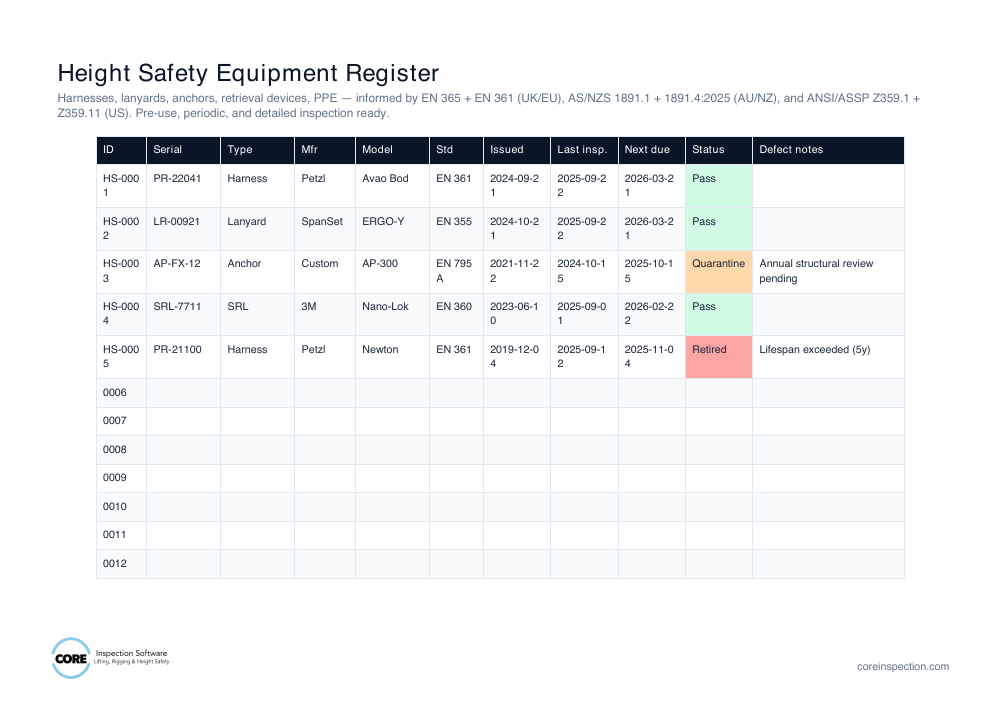
Designed for safety managers and inspection engineers to keep height safety PPE compliant and traceable from issue to retirement.
- Unique ID, manufacturer, model, and serial
- Equipment type (harness, lanyard, SRL, anchor, connector)
- Date of manufacture and date of issue
- Last inspection and next-due fields
- Pass / Fail / Quarantine / Retired status
- Issued-to user or storage location
- Defect notes and corrective action column
- Retirement date with cause field (age, damage, recall)
- Conditional formatting for due dates
- Filter-ready table for any asset count
Who uses this register
Anyone responsible for the safe use, inspection, or retirement of height safety PPE.
Site safety managers
Construction and industrial sites where workers depend on PPE every day.
PPE distributors & inspectors
Companies issuing, inspecting, and recertifying gear for client sites.
Wind, telecoms & utility teams
Tower-rope and rescue teams managing fleets of high-rotation gear.
Competent persons
Qualified inspectors documenting periodic detailed examinations.
Standards this register is informed by
The register is jurisdiction-aware: a 'Standard' column lets you tag each item, and the field set captures everything EN, AS/NZS, and ANSI inspections need.
Europe / UK: EN 365 + EN 361
EN 365:2004 sets the general requirements for fall protection PPE: instructions, maintenance, periodic examination, repair, marking. Periodic examination is by a competent person at intervals not exceeding 12 months (more often in intensive use). EN 361 specifies full-body harnesses; EN 354/355 cover lanyards; EN 360 self-retracting devices; EN 362 connectors; EN 795 anchors. In UK law, the Work at Height Regulations 2005 drive the inspection duty for fall-arrest kit, backed by the Personal Protective Equipment at Work Regulations 1992 (as amended 2022) and HSE's INDG367 guidance.
- Periodic examination ≤ 12 months by a competent person
- Detailed inspection records retained until next examination
- Manufacturer authorisation may be required for some equipment (e.g. SRLs)
Australia / NZ: AS/NZS 1891.4:2025 + NATA
AS/NZS 1891.4:2025 is the current standard for Selection, Use and Maintenance; it superseded the 2009 version. AS/NZS 1891.1 covers the harnesses themselves, .2 horizontal lifelines/rails, .3 fall arrest devices. The 2025 update clarified inspection frequencies and competent-person requirements. In Australia, periodic and detailed inspections are commonly performed by NATA-accredited inspection bodies under ISO/IEC 17020.
- AS/NZS 1891.1 / .2 / .3 / .4: multi-part standard
- Pre-use, periodic (typically 6-monthly), detailed inspection
- NATA accreditation under ISO/IEC 17020 widely recognised
- Inspector qualification + NATA number captured per record
United States: ANSI/ASSP Z359 + OSHA
ANSI/ASSP Z359.1-2024 is the umbrella Fall Protection Code; ANSI/ASSP Z359.2-2023 establishes the managed fall protection program and the role of the Competent Person. Z359.11-2021 specifies full body harnesses; Z359.13 covers personal energy absorbers and lanyards; Z359.14-2021 covers self-retracting devices. OSHA 1910.140 (general industry) and 1926.502 (construction) are the federal regulations sitting on top.
- ANSI/ASSP Z359.1-2024: umbrella Fall Protection Code
- Z359.2-2023: managed fall protection program + Competent Person
- Z359.11: full body harness specification
- Z359.13: energy absorbers and lanyards
- Z359.14: self-retracting devices (SRDs)
- OSHA 1910.140 / 1926.502: federal regulation
When PPE must be retired
A register's job is to make retirement obvious, so it is never a judgement call under pressure. The retirement triggers below are universal across EN 365, AS/NZS 1891.4 and ANSI Z359.
- Manufacturer's stated lifespan exceeded (typically 5–10 years from first use)
- Visible damage, abrasion, or chemical exposure
- Subject to a fall arrest event (regardless of visual condition)
- Failed periodic or detailed inspection
- Manufacturer recall or revoked certification
Typical inspection intervals
Default minimums. Your manufacturer may require more frequent checks for high-use environments.
| Equipment | Minimum interval | Notes |
|---|---|---|
| Full body harnesses | 6 months | More frequently in abrasive or chemical environments |
| Lanyards & energy absorbers | 6 months | Retire immediately after fall arrest deployment |
| Self-retracting devices (SRLs) | Annually | Some manufacturers require return-to-base service |
| Anchor points (permanent) | Annually | Plus structural review after any loading event |
Frequently asked questions
Pre-use checks are done by the user. Periodic and detailed inspections must be carried out by a 'competent person' as defined in the applicable standard. EN 365 defines the competent person as someone knowledgeable of current periodic-examination requirements and manufacturer instructions. AS/NZS 1891.4:2025 has its own definition. ANSI/ASSP Z359.2-2023 establishes the Competent Person role within a managed fall-protection program. In Australia, NATA-accredited inspection bodies (ISO/IEC 17020) are widely used.
Related resources
More free templates and resources for inspection professionals.
Still managing inspections on paper?
Core Inspection software helps lifting equipment companies reduce admin time by 40-60%. Generate professional certificates, manage equipment registers, and automate scheduling, all in one platform.
Trusted by inspection companies serving 150,000+ organisations worldwide