Free Lifting Equipment Register Template
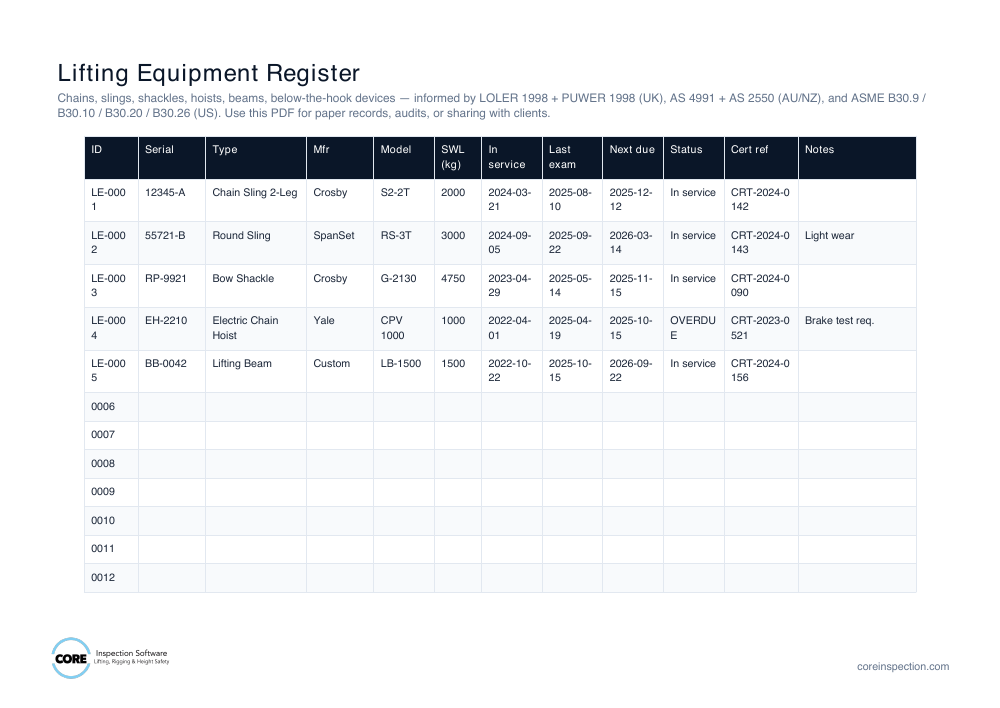
A ready-to-use Excel register for tracking every piece of lifting equipment in your fleet: chains, slings, shackles, hoists, beams. Serial numbers, SWL, last and next inspection dates, certificate references, all in one place. Informed by LOLER + PUWER (UK), AS 4991 + AS 2550 (AU/NZ), and ASME B30 (US).
Download Free Lifting Equipment Register
Enter your details below to get instant access.
What's in the register
This template gives you a single source of truth for every piece of lifting equipment your business is responsible for. Simple to maintain, ready to hand to an auditor, and structured to migrate into Core Inspection when you outgrow the spreadsheet.
- Equipment ID and serial number columns
- Equipment type, manufacturer, model fields
- Safe Working Load (SWL) and capacity
- Date of first put-into-service
- Last thorough examination date
- Next examination due date with conditional formatting
- Certificate reference and storage location
- Status field (in-service, out-of-service, scrapped)
- Notes column for defects and observations
- Filter-ready table format
Who uses this register
Anyone responsible for keeping track of lifting equipment fleets, whether you own them, hire them out, or inspect them.
Lifting equipment companies
Track gear sold, hired or maintained for clients, with full audit history per asset.
End-user duty holders
Construction, manufacturing, and warehousing operations meeting LOLER duties.
In-house safety teams
H&S managers responsible for making sure all lifting gear is examined on schedule.
Competent persons
Inspection engineers wanting a clean register format to share with clients.
Standards this register is informed by
Different jurisdictions, same purpose: a defensible record of every piece of lifting equipment, examined on schedule by a competent person.
United Kingdom: LOLER + PUWER
LOLER 1998 (Lifting Operations and Lifting Equipment Regulations) is the statutory framework for thorough examination of lifting equipment. PUWER 1998 (Provision and Use of Work Equipment Regulations) applies in addition to LOLER because lifting equipment is also work equipment. Reg 5 requires maintenance of all work equipment, and Reg 6 requires inspection where safety depends on installation conditions or where exposure causes deterioration liable to result in dangerous situations. LOLER Schedule 1 specifies what a Report of Thorough Examination must contain.
- Every piece of lifting equipment uniquely identified
- Examined at statutory minimum frequencies (see table below)
- Records retained for at least 2 years or until next examination
- Defects and corrective actions tracked
- Records available to HSE on request
Australia / New Zealand: AS 4991, AS 2550, NATA
AS 4991 covers below-the-hook lifting devices. AS 2550.x is the multi-part standard for safe use of cranes, hoists and winches (with AS 1418.x covering design). For inspection providers, NATA accreditation under ISO/IEC 17020 with a lifting-equipment scope of accreditation is what regulators, insurers and clients commonly look for. The register fields are designed to capture inspector qualification and NATA accreditation number where relevant.
- AS 4991: design, proof testing, periodic inspection of lifting devices
- AS 2550.x: safe use of cranes/hoists/winches (multi-part)
- NATA / ISO/IEC 17020: accredited inspection bodies
- Major inspection thresholds (commonly 10y mechanical / 25y structural)
United States: ASME B30 series + OSHA
The ASME B30 family is the safety-standard bedrock for lifting in the US. Different parts cover different equipment types: B30.9 for slings, B30.10 for hooks, B30.20 for below-the-hook devices, B30.26 for rigging hardware. OSHA 1910.184 is the federal regulation covering slings; the law sits on top of the standard.
- ASME B30.9: slings (frequencies, criteria, removal-from-service)
- ASME B30.10: hooks (throat opening ≤5%, no cracks)
- ASME B30.20: below-the-hook lifting devices
- ASME B30.26: rigging hardware (shackles, eyebolts, turnbuckles)
- OSHA 1910.184: federal sling regulation
Statutory examination intervals (UK / LOLER 1998)
Use as a quick reference for setting the 'next due' field. AU/NZ and US frequencies vary by standard and equipment type; see the Standards Reference sheet inside the template.
| Equipment | Minimum frequency | Examples |
|---|---|---|
| Equipment for lifting persons | 6 months | MEWPs, passenger lifts, suspended access platforms |
| Lifting accessories | 6 months | Slings, shackles, eyebolts, lifting beams |
| Other lifting equipment | 12 months | Cranes, hoists, fork-lift trucks (typical use) |
| Adverse environments | As specified | Marine, offshore, high-temperature: competent person decides |
Frequently asked questions
A spreadsheet can be enough for a small fleet, but it has real limits. LOLER doesn't mandate software. Schedule 1 specifies the content of a Report of Thorough Examination, not the format of the supporting register. PUWER 1998 also requires inspection, with results recorded, where equipment is exposed to conditions causing deterioration liable to result in dangerous situations. Spreadsheets get out of sync, miss due dates, and fall apart at scale. Most companies move to dedicated register software once they pass roughly 200 assets or three branches.
Related resources
More free templates and resources for inspection professionals.
Still managing inspections on paper?
Core Inspection software helps lifting equipment companies reduce admin time by 40-60%. Generate professional certificates, manage equipment registers, and automate scheduling, all in one platform.
Trusted by inspection companies serving 150,000+ organisations worldwide