Free AS 4991 Lifting Device Certification Template
Below-the-hook lifting devices (spreader bars, lifting beams, custom attachments) require design certification, proof load testing, and periodic inspection under AS 4991:2004 in Australia. This template gives you a one-document record covering all three, with sign-off blocks for the certifying engineer (RPEng / RPEQ / CPEng) and competent person.
Download Free Lifting Device Certification (AS 4991)
Enter your details below to get instant access.
What's in the record
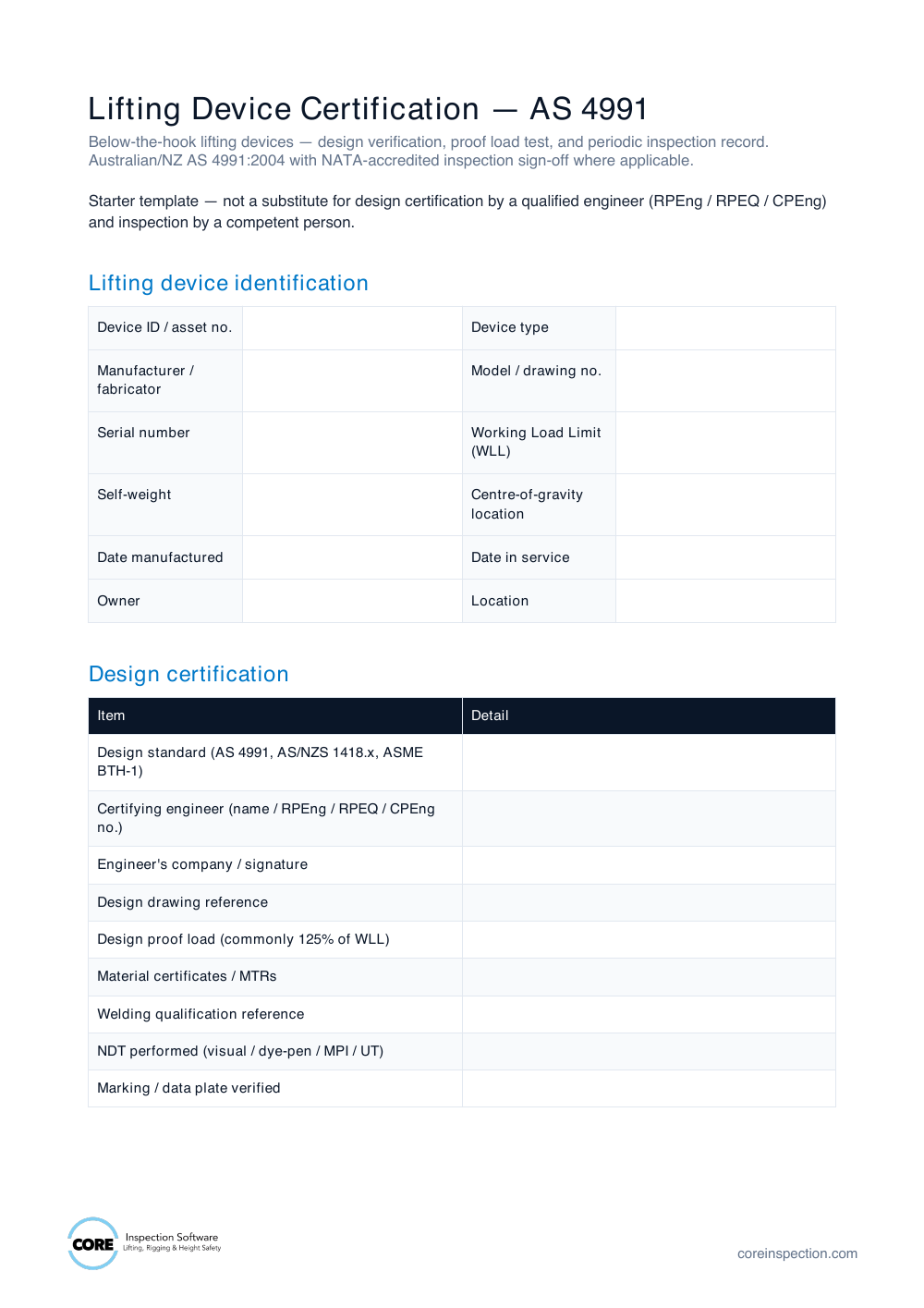
A complete certification artifact for a single lifting device, from design verification through proof load to ongoing periodic inspection.
- Device identification (ID, type, manufacturer, model, serial, WLL, self-weight, COG)
- Design certification block: engineer details, drawing reference, design proof load, MTRs, welding qualification, NDT
- Proof load test record: test load, method, duration, deflection, witness
- Periodic inspection log (6 blank rows + reference to register template for ongoing tracking)
- Certification sign-off with RPEng / RPEQ / CPEng number and NATA accreditation
- Standards reference page covering AS 4991, AS 1418, AS 2550, NATA, ASME BTH-1
Who uses this template
Anyone designing, fabricating, certifying, or inspecting below-the-hook lifting devices in Australia or New Zealand.
Lifting device fabricators
Custom-fabrication shops issuing certification with each device.
End-user duty holders
Mining, construction, manufacturing operators procuring and using AS 4991 devices.
Certifying engineers (RPEng / RPEQ / CPEng)
Chartered engineers verifying design and proof load.
NATA-accredited inspection bodies
ISO/IEC 17020 inspection providers performing periodic inspections.
Standards this record is informed by
AS 4991:2004 is the Australian standard for below-the-hook lifting devices. It sits alongside AS 1418 (crane design) and AS 2550 (safe use) and integrates with NATA accreditation for ongoing inspection.
What AS 4991 covers
AS 4991:2004 specifies design, proof testing, marking, and periodic inspection of below-the-hook lifting devices. This includes spreader bars, lifting beams, plate clamps, drum lifters, crane forks, magnet lifters, and custom attachments. Design certification by a qualified engineer is required before first use; proof load testing (2 × WLL for devices with WLL up to 10 t, with a sliding scale above that) is required at certification and after major repair, or alternative verification by engineering analysis plus a reduced test load.
- Design verification by qualified engineer
- Proof load test before first use
- Periodic inspection by competent person
- Marking with WLL and identification
- Records retained through device life
Engineering credentials
Design certification under AS 4991 must be performed by a qualified engineer. In Australia, the recognised credentials are RPEng (Engineers Australia), RPEQ (Queensland Board of Professional Engineers), or CPEng (Engineers Australia chartered). Each state's WHS regulator looks for these credentials when reviewing certification documents.
- RPEng: Engineers Australia, national
- RPEQ: Queensland (statutory)
- CPEng: Engineers Australia chartered
- International equivalents accepted with assessment
NATA-accredited periodic inspection
Once certified, AS 4991 devices need periodic inspection by a competent person. In Australia this is commonly performed by NATA-accredited inspection bodies under ISO/IEC 17020. The default frequency is 12 months; severe service may shorten that. The record has a periodic inspection log section with 6 blank rows for ongoing tracking.
- Default frequency: 12 months
- More often in severe service
- NATA accreditation under ISO/IEC 17020
- For larger fleets, use the Lifting Equipment Register template
Frequently asked questions
Anything that connects to the crane hook to lift a load. Spreader bars, lifting beams, plate clamps, drum lifters, crane forks, magnet lifters, vacuum lifters, custom attachments. Standard rigging is governed by other standards (chain slings AS 3775, wire rope slings AS 1666, shackles AS 2741, synthetic round slings AS 4497, and EN 13414 / ASME B30.9 internationally) and not by AS 4991.
Related resources
More free templates and resources for inspection professionals.
Still managing inspections on paper?
Core Inspection software helps lifting equipment companies reduce admin time by 40-60%. Generate professional certificates, manage equipment registers, and automate scheduling, all in one platform.
Trusted by inspection companies serving 150,000+ organisations worldwide