Free Crane Hook Inspection Sheet — ASME B30.10
ASME B30.10's removal-from-service criteria are measurable numbers: throat opening greater than 5%, any visibly apparent bend or twist from the plane of the unbent hook, wear greater than 10% of section. This template gives you a per-hook inspection record with those measurements built in, plus a removal-criteria reference card.
Download Free Hook Inspection Sheet (ASME B30.10)
Enter your details below to get instant access.
What's in the sheet
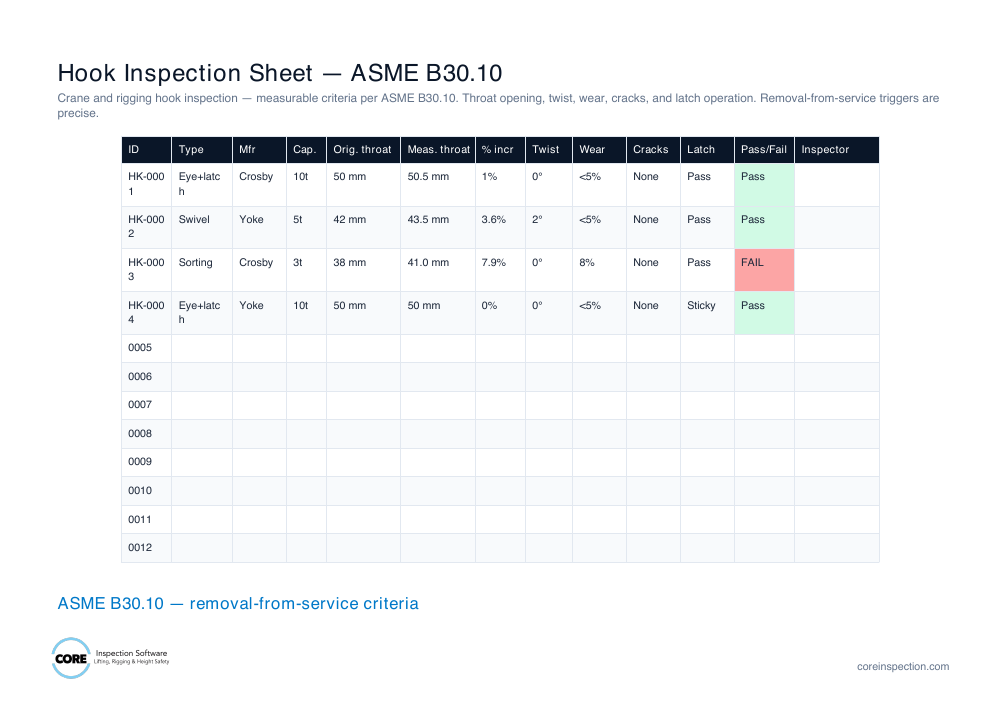
Hook-specific measurable criteria, designed to capture B30.10's exact thresholds as measurements.
- Hook ID, type (eye / swivel / sorting), manufacturer, capacity
- Original throat opening (mm or in)
- Measured throat opening with % increase calculation
- Bend / twist check (any visible deformation from plane)
- Wear (% of original section)
- Cracks / NDT result
- Latch operation (Pass / Fail / Sticky)
- Pass / Fail outcome with auto-tinted cells
- Inspector field
- Notes column for observations or corrective action
- Separate sheet: full B30.10 removal-from-service criteria card
Who uses this sheet
Anyone who inspects hooks under ASME B30.10, from rigging crews to overhead-crane maintenance teams.
Rigging crews
Pre-use and frequent hook checks during lifts.
Crane maintenance teams
Periodic hook inspection on overhead, mobile, and tower cranes.
Designated inspectors
Documented inspections for crane and rigging fleets.
QA / engineering
Verifying NDT and corrective action on flagged hooks.
Standards this sheet is informed by
ASME B30.10 is unusually specific about hook removal criteria. Hooks are also covered by reference in B30.9 (slings) and B30.26 (rigging hardware).
ASME B30.10: measurable criteria
B30.10 specifies exactly what triggers removal from service, so no judgement call is required. The current edition is ASME B30.10-2024 (published January 2025, effective January 2026). The most-cited triggers: throat-opening increase greater than 5% of original (or 1/4 inch / 6 mm, whichever is less); any visibly apparent bend or twist from the plane of the unbent hook, stricter than the legacy 10° figure, which survives in OSHA 1910.179(j) for crane hooks; wear greater than 10% of the original section dimension. Cracks, missing or non-functional latches, evidence of heat or chemical damage, and missing identification all trigger removal.
- Throat opening: 5% increase or 1/4 inch / 6 mm (whichever less)
- Bend / twist: any visibly apparent deformation from the plane of the unbent hook
- Wear: 10% of original section
- Cracks: verify with NDT
- Latch: must function and seat correctly
- Identification: manufacturer and capacity must be legible
Hooks in the wider rigging context
Hooks rarely live alone. ASME B30.9 (slings) commonly uses integrated hooks; B30.26 (rigging hardware) covers connected components like shackles and links. OSHA 1910.179 (overhead/gantry) and 1910.180 (mobile cranes) reference B30.10 for hook inspection. Where hooks are part of a sling assembly, both B30.9 and B30.10 apply.
- ASME B30.9: slings (with integrated hooks)
- ASME B30.26: rigging hardware
- OSHA 1910.179 / 1910.180: federal crane regs
- AS 4991 + AS 2550: Australian equivalents (cross-reference)
Frequently asked questions
Use a caliper or specialised hook gauge to measure the throat at its widest point. Compare to the original throat opening from the manufacturer's specification or original-condition record. The percentage increase is the trigger; B30.10 sets 5% as the cap (or 1/4 inch / 6 mm, whichever is less). Many shops record the original throat at first inspection so the calculation is easy thereafter.
Related resources
More free templates and resources for inspection professionals.
Still managing inspections on paper?
Core Inspection software helps lifting equipment companies reduce admin time by 40-60%. Generate professional certificates, manage equipment registers, and automate scheduling, all in one platform.
Trusted by inspection companies serving 150,000+ organisations worldwide