Free Tail Lift LOLER Inspection Sheet — Thorough Examination Template
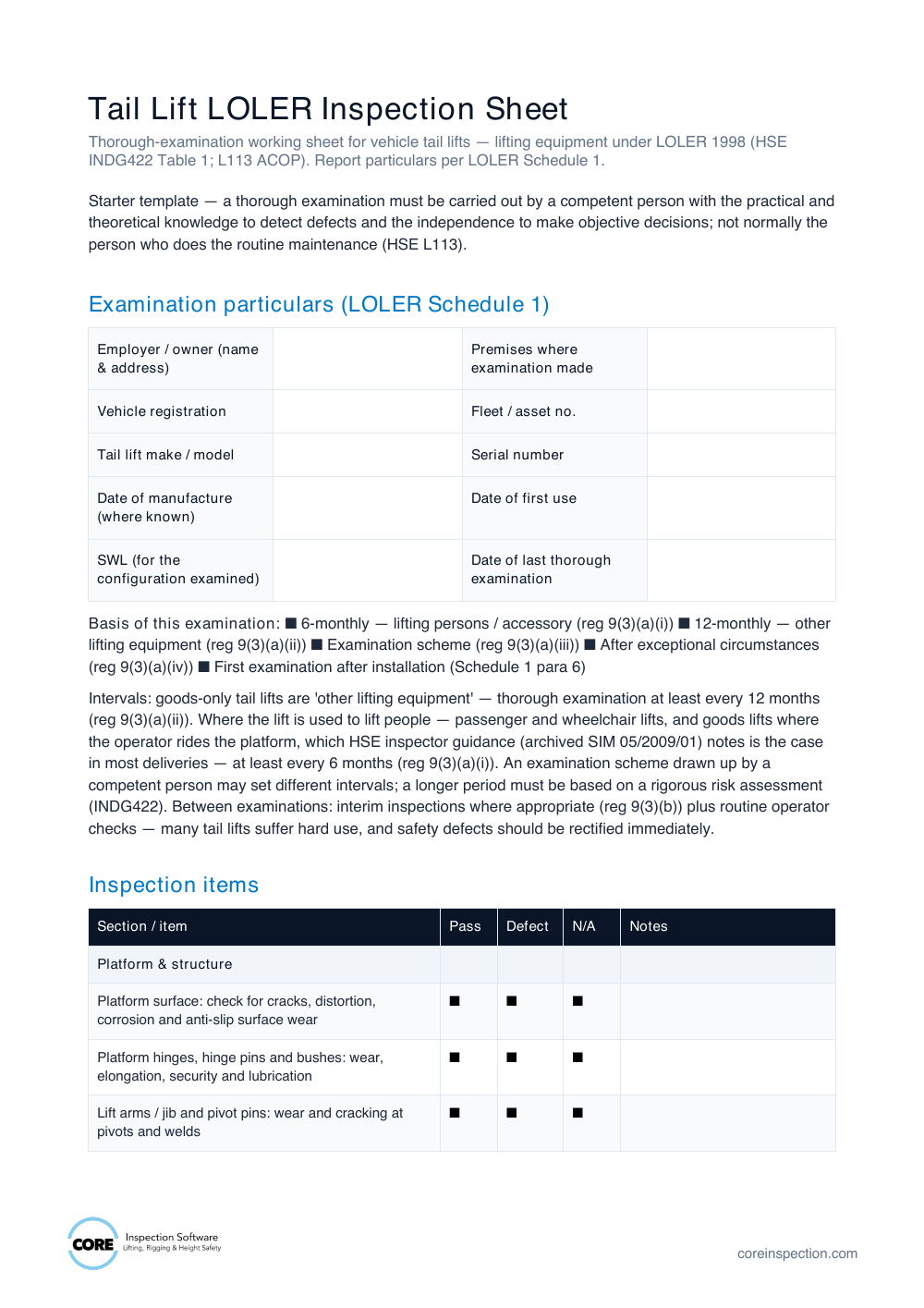
A thorough-examination sheet for vehicle tail lifts under LOLER 1998. Five inspection sections (platform & structure, hydraulics, electrical & controls, safety devices & markings, operational tests) plus fields for every particular Schedule 1 requires in the report. Works for goods lifts (BS EN 1756-1) and passenger lifts (BS EN 1756-2).
Download Free Tail Lift LOLER Inspection Sheet
Enter your details below to get instant access.
What's on the sheet
A five-section examination checklist that works across cantilever, tuckaway, column and slider lifts, with the defect and report fields the law fixes, so nothing gets recorded on the back of a job card.
- Platform & structure: platform surface, hinges and pins, lift arms and pivots, torsion bars/tilt mechanism where fitted, chassis mounting, roll-stops and toe guards
- Hydraulics: ram condition and seal leaks, hose and fitting chafe, power pack and oil, holding valve proved against platform creep under load
- Electrical & controls: control box and isolator, wiring and battery connections, hold-to-run response on release, auxiliary controls (cab isolator, wander lead)
- Safety devices & markings: SWL plate legibility, warning decals and operating instructions, platform visibility aids, emergency stop and emergency lowering
- Operational tests: full-travel raise/lower, tilt and bed-level alignment, rated-load test where the competent person requires it, stow-and-lock for road travel
- Interval selector: 6-monthly (lifts persons), 12-monthly (goods only) or per examination scheme
- Defects split the way Schedule 1 splits them: a danger now, or could become a danger, with the time limit attached
- Next thorough-examination due date and examiner particulars
- Identification fields for the Schedule 1 particulars: employer, premises, equipment identification, SWL, date of last examination
- Word version fully editable for your own branding and report format
Who this sheet is for
Tail lifts live in fleets, so the sheet is built for the examiner doing the rounds and the dutyholder keeping the fleet legal.
Tail lift service & inspection companies
Engineers carrying out thorough examinations across customer fleets and issuing the reports.
Transport & logistics fleets
Dutyholders under LOLER for delivery vehicles running cantilever, tuckaway, column or slider lifts.
Passenger transport operators
Coach, ambulance and accessible-vehicle operators on the 6-monthly cycle for lifts that carry people.
Workshop & fleet engineers
Running interim inspections and routine operator checks between thorough examinations.
Tail lifts and LOLER: what the law actually asks for
The thorough examination is a statutory event with fixed intervals, a fixed report format, and rules about who can sign it.
Yes, tail lifts are lifting equipment under LOLER
This one isn't arguable. HSE lists 'vehicle tail lifts' by name in Table 1 of INDG422, its employer guide to thorough examination, and the LOLER Approved Code of Practice (L113) names vehicle tail lifts as lifting equipment and uses one as an example of routine lifting operations. So every tail lift in a fleet needs statutory thorough examination by a competent person. The MOT and a service history don't cover it.
- Named in HSE INDG422 Table 1 ('Equipment covered by LOLER') and in the L113 ACOP
- Thorough examination is separate from routine maintenance and from the vehicle's own tests
- The competent person must have the practical and theoretical knowledge and experience of tail lifts to detect defects and judge how much they matter
- They must be sufficiently independent and impartial. In-house examiners are allowed under L113 if they have genuine authority and independence, but the person who maintains the lift should not normally be the one who examines it
Between examinations: interim inspections and operator checks
The thorough examination isn't the whole regime. LOLER regulation 9(3)(b) requires inspection by a competent person at suitable intervals between thorough examinations where appropriate; HSE describes these as visual and functional checks at regular intervals such as weekly, monthly or quarterly. HSE's tail-lift guidance goes further: many lifts suffer hard use, so a system of routine checks is expected, with any safety defect rectified immediately. PUWER 1998 separately covers maintenance and inspection of the non-lifting parts of the unit.
- Interim inspections where risk assessment identifies significant risk, scope and frequency set by the competent person
- Routine operator checks: industry practice is a documented weekly check plus a pre-use look-over
- Common defect areas: hydraulic hose chafe and leaks, platform cracks and anti-slip wear, loose hinge pins and mounting bolts, holding-valve creep, dead e-stops, illegible decals
- Safety defects get fixed immediately, not noted for the next service
The report: what LOLER Schedule 1 makes you record
Whatever format your report takes, Schedule 1 fixes its contents, and the sheet carries a field for each particular. The defect section splits findings the way the law does: defects that are a danger to persons now, versus defects that could become one, with the date by which they will.
- Employer name and address, the premises examined at, and equipment identification including date of manufacture where known
- Safe working load, or the SWL for the configuration examined, where it depends on configuration
- Which examination it was: 6-monthly, 12-monthly, under an examination scheme, or after exceptional circumstances
- Defects, the repairs or alterations needed to remedy them, and time limits for developing defects
- Latest date for the next thorough examination, particulars of any test, and the examiner's name, address and qualifications
- Serious defects: the competent person notifies the employer forthwith, then issues the written report, with a copy to the relevant enforcing authority where there's an existing or imminent risk of serious personal injury
- L113 guidance: in normal circumstances the written report should reach you within 28 days of the examination
BS EN 1756: the product standard behind the lift
LOLER governs the in-service examination; BS EN 1756 governs how the lift was designed and built. It comes in two parts, one for goods lifts and one for passenger lifts, and recording which standard the lift was built to belongs in the equipment particulars.
- BS EN 1756-1:2021: tail lifts for goods (current edition, published August 2021, replacing the 2001+A1:2008 version)
- BS EN 1756-2:2004+A1:2009: tail lifts for passengers (still the current edition as of 2026)
- The operational-test section proves the lift still does what its design standard intended: full travel, level alignment, load held without creep
Tail lift thorough-examination intervals
LOLER regulation 9(3)(a) defaults. The periods are maxima, not targets. An examination scheme drawn up by a competent person can set different intervals, but a longer period must be based on a rigorous risk assessment.
| Tail lift use | Interval | Why |
|---|---|---|
| Goods only (nobody rides the platform) | At least every 12 months | 'Other lifting equipment' under reg 9(3)(a)(ii) |
| Lifts persons: passenger and wheelchair lifts on coaches, ambulances, accessible vehicles | At least every 6 months | Lifting equipment for lifting persons, reg 9(3)(a)(i) |
| Goods lift where the operator rides the platform | At least every 6 months | HSE inspector guidance (now archived) treats riding the platform as lifting persons, and noted that's most deliveries |
| Under an examination scheme | Per the scheme | Drawn up by a competent person for the specific lift and conditions; reviewed at each examination |
| After exceptional circumstances | Each time they occur | Damage or failure, long out-of-use periods, or a major change in use liable to affect integrity |
Frequently asked questions
Yes. HSE lists 'vehicle tail lifts' by name in Table 1 of INDG422, its employer guide to thorough examination of lifting equipment, and the LOLER Approved Code of Practice (L113) names vehicle tail lifts as lifting equipment subject to LOLER. Every tail lift therefore needs statutory thorough examination by a competent person, on top of routine maintenance and separate from the vehicle's own tests.
Related resources
More free templates and resources for inspection professionals.
LOLER ROTE Template
Report of Thorough Examination template with all Schedule 1 fields, in PDF and Word.
View resourceGuide: LOLER Inspection Frequency
6-monthly, 12-monthly and examination schemes: which interval applies to what.
View resourceLOLER Inspection Software
Schedule examinations, capture findings on mobile, and issue branded ROTEs.
View resourceExamining tail lifts across whole fleets?
Core Inspection schedules the 6- and 12-monthly examinations per vehicle, captures findings on mobile, and renders Reports of Thorough Examination from your own DOCX template, with the audit trail HSE will ask for.
Trusted by inspection companies serving 150,000+ organisations worldwide