Free DNV 2.7-1 Lifting Set Inspection Record — DNV-ST-E271
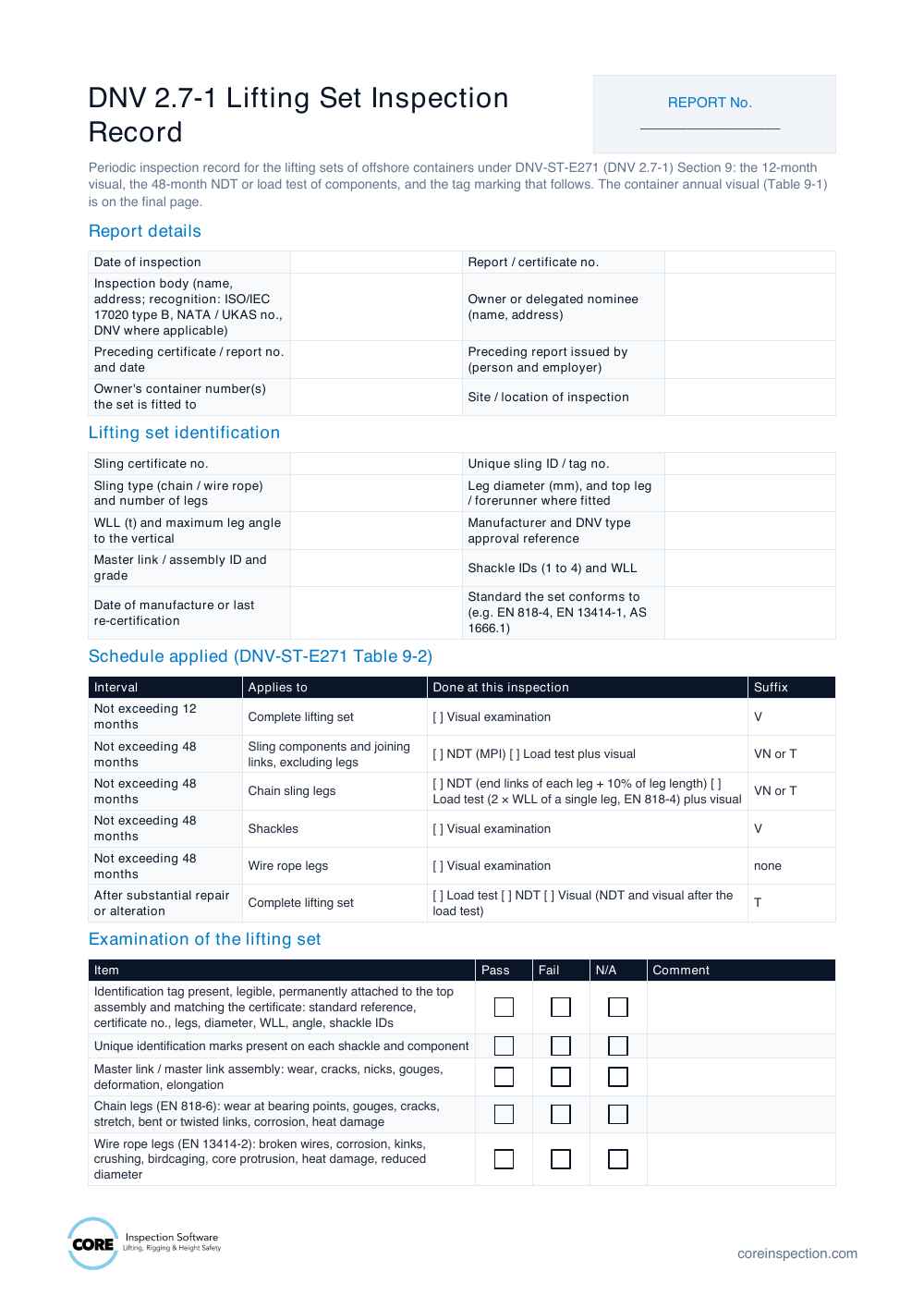
A two-page record for the periodic inspection of offshore container lifting sets under DNV-ST-E271, the standard still known as DNV 2.7-1. Page one follows the Table 9-2 schedule for the sling: the 12-month visual, the 48-month NDT or load test of components, the result and the V, VN or T suffix marked on the tag. The final page is the container's annual visual against Table 9-1, with the pad eye NDT and plate marking fields.
Download Free DNV 2.7-1 Lifting Set Inspection Record
Enter your details below to get instant access.
What's in the record
Every field the Section 9 inspection report has to carry, grouped the way an inspector works through a lifting set: who and when, which set, what the schedule required this time, what was found, what was marked.
- Report details: date, report number, inspection body with its recognition (ISO/IEC 17020 type B, NATA or UKAS number), owner or delegated nominee, site
- The preceding certificate or report: number, date, who issued it and their employer, which the standard requires on every report
- Lifting set identification: sling certificate number, unique sling ID, type and number of legs, leg diameter and top leg, WLL with the maximum angle, manufacturer and DNV type approval reference, master link and shackle IDs, date of manufacture or last re-certification
- Schedule applied: the Table 9-2 rows for the complete set, components and joining links, chain legs, shackles and wire rope legs, with tick boxes for NDT or load test and the suffix each one earns
- Twelve examination items covering the tag, component marking, master link assembly, chain legs (EN 818-6), wire rope legs (EN 13414-2), terminations, shackles, couplings, geometry and overall condition, each with pass, fail, N/A and comment
- NDT and load test details: method, procedure, operator certification, report reference, load per leg in kN, hold time, test equipment and calibration reference
- Result, defects and actions, confirmation the tag was marked in column 1 with date, inspector's mark and suffix, and column 2 revised if shackles were replaced
- Next 12-month and 48-month due dates, inspector's name and unique identification mark, authorised signatory
- Final page: container identification, data plate and inspection plate check, the eight visual inspection items from the standard, pad eye NDT and lifting test fields, result, plate marking with suffix
- Footnotes on what the record is and is not, and on the national rules that sit alongside the DNV schedule
Who uses this record
Built for the companies that inspect and test offshore containers and their slings for owners, and for the owners who have to keep the certificate valid.
Inspection bodies and test houses
ISO/IEC 17020 bodies and NATA or UKAS accredited labs issuing periodic inspection reports under the standard.
Lifting set manufacturers
Sling shops with DNV type approval re-certifying their own sets at the 48-month point.
CCU rental fleets and container owners
Owners responsible for arranging inspections and keeping the records that prove each unit is current.
Offshore logistics and HSE teams
The people who have to confirm currency before a container goes to the quayside.
What DNV-ST-E271 Section 9 asks for
The schedule is short, but the record has to prove each line was met. The fields on this template map to the standard's own lists.
Two schedules, three suffixes
The container and its lifting set run on separate schedules. The container gets a visual at intervals not exceeding 12 months, NDT of the pad eyes with a visual at intervals not exceeding 48 months, and a lifting test followed by NDT and visual after any substantial repair or alteration. The lifting set gets a visual of the complete set every 12 months; at 48 months the components and joining links get either NDT or a load test, chain legs get either NDT or a load test, shackles get a visual and wire rope legs get a visual only. Each inspection is marked with a suffix: V, VN or T.
- V: visual examination only
- VN: NDT plus visual examination
- T: proof load test, NDT and visual examination
- Container: marked on the inspection plate with the date and the inspector's mark
- Lifting set: marked in column 1 on the back of the sling tag
What the report must contain
Section 9 lists what an inspection report shows at minimum: the container or lifting set identification with the owner's container number, the owner's name, the certificate number, the date and number of the preceding certificate of examination with the issuer and their employer, the test mass and method where a lifting test was done, details of any NDE, a statement that the unit was thoroughly examined and the particulars are correct, confirmation that the plate or tag was marked, the date of inspection, and the DNV mark with the inspector's signature and unique identification mark. The reference to the preceding report is the field most in-house forms leave out.
- Owner's container number on every report
- Preceding certificate: number, date, issuer, employer
- NDE details and test particulars where performed
- Confirmation the plate or tag was marked
- Inspector's unique identification mark
Tag marking and what it has to match
The sling tag is the field document. It carries the reference DNV 2.7-1, the certificate number and unique sling ID, the number of legs, the chain or rope diameter including any top leg, the WLL, the maximum leg angle and the identification number of each shackle. The first examination item on this record is whether the tag still says all of that legibly and matches the certificate. If shackles are replaced at an inspection, column 2 on the back of the tag is revised or the tag is replaced, and the new shackle IDs go on the report.
- Round metal tag for wire rope slings, eight-sided for grade 8 chain
- Characters at least 4 mm high, permanently stamped or embossed
- Shackles individually stamped with a unique identification
- Two 2-leg slings used as a 4-leg set are both marked as 4-leg
Test loads and inspection standards
Where the 48-month schedule calls for a load test on chain legs, the test load is twice the WLL of a single leg rated to EN 818-4, within 2 percent, applied without shock and held for at least 2.5 minutes before measurement. NDT of components is magnetic particle testing to the production requirements. The slings themselves are inspected to EN 818-6 for chain and EN 13414-2 for wire rope. The record carries fields for the procedure, the operator's certification and the report reference so the inspection body's own traceability is on the page.
- Chain legs: 2 × single-leg WLL, 2.5 minutes, EN 818-4 rating
- Chain leg NDT: end links of each leg plus 10 percent of the leg length
- MPI for components; eddy current accepted on the container's painted welds
- Load tests need calibrated equipment with a traceable reference
Table 9-2 at a glance
Summary of the lifting set schedule. The standard governs; this record exists to prove each row was done.
| Interval | Applies to | Required |
|---|---|---|
| Not exceeding 12 months | Complete lifting set | Visual examination. Suffix V on the tag |
| Not exceeding 48 months | Sling components and joining links, excluding legs | Visual plus either NDT or load test. Suffix VN or T |
| Not exceeding 48 months | Chain sling legs | Visual plus either NDT (end links plus 10% of leg length) or load test. Suffix VN or T |
| Not exceeding 48 months | Shackles | Visual examination. Suffix V |
| Not exceeding 48 months | Wire rope legs | Visual examination only |
| After substantial repair or alteration | Complete lifting set | Load test, then NDT and visual. Suffix T |
| Container (Table 9-1) | Every 12 months; pad eye NDT at 48 months | Visual every 12 months (V); NDT of pad eyes plus visual at 48 months (VN); lifting test after substantial repair (T) |
Frequently asked questions
It is a working record that carries every field Section 9 of DNV-ST-E271 requires on a periodic inspection report, in the order an inspector fills them in. Whether a report is accepted as the periodic inspection depends on who signs it: DNV, or an inspection body recognised by the national authorities, normally one that meets ISO/IEC 17020 type B. The record does not reproduce the standard's text, and it does not replace the DNV container certificate the owner holds.
Related resources
More free templates and resources for inspection professionals.
DNV 2.7-1 inspection guide
Intervals, certificate contents, who can sign, and how 2.7-1 relates to 2.7-3, EN 12079 and ISO 10855.
View resourceLoad Test Certificate
The proof load certificate for the test side of a 48-month or post-repair inspection.
View resourceSling Inspection Log (ASME B30.9)
Periodic sling inspection records for the US workshop, with removal-from-service criteria.
View resourceStill managing inspections on paper?
Core Inspection software helps lifting equipment companies reduce admin time by 40-60%. Generate professional certificates, manage equipment registers, and automate scheduling, all in one platform.
Trusted by inspection companies serving 150,000+ organisations worldwide