Free Load Test Certificate Template — Proof Load Testing
A multi-jurisdiction proof load test certificate for cranes, lifting devices, slings and accessories. Test loads range from a 125% cap (OSHA cranes) to 2.5× WLL (chain at manufacture) depending on the standard, so the certificate records the standard applied, the actual load, the test method and the calibration references. The fields an auditor actually checks.
Download Free Load Test Certificate
Enter your details below to get instant access.
What's on the certificate
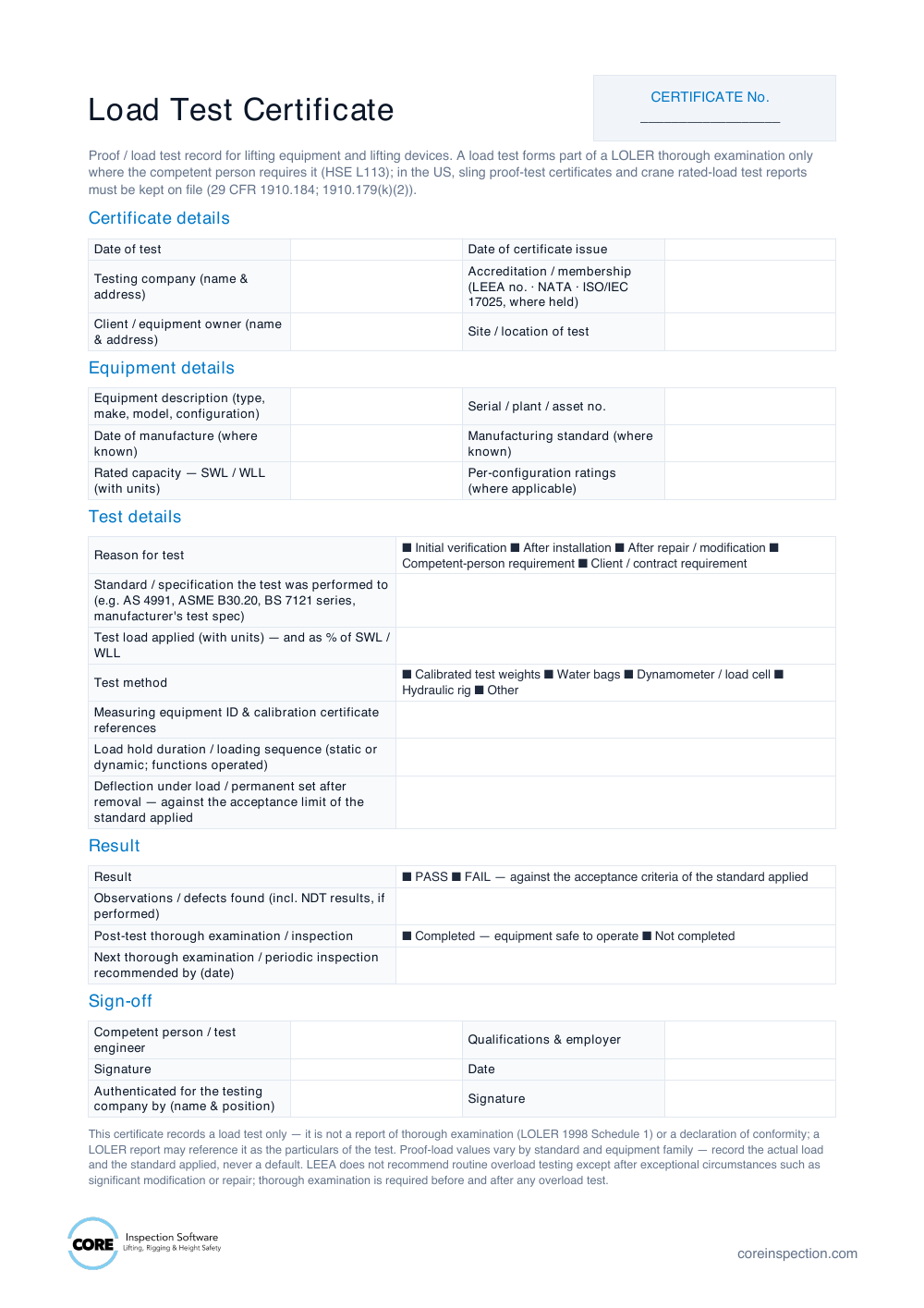
Every field a defensible proof load test certificate needs, grouped the way a test engineer works: certificate details, equipment, test details, result, sign-off. Because proof-load percentages vary by standard and equipment family, the test-details block asks what you tested to and never assumes a default.
- Certificate number, date of test and date of issue
- Testing company details with accreditation / membership fields: LEEA membership no., NATA, ISO/IEC 17025 where held
- Client / equipment owner, and the site where the test was carried out
- Equipment description (type, make, model, configuration), serial / plant / asset ID, date of manufacture and manufacturing standard where known
- Rated capacity: SWL / WLL with units, per-configuration ratings where applicable
- Reason for test: initial verification / after installation / after repair or modification / competent-person or contract requirement
- Standard or specification tested to (e.g. AS 4991, ASME B30.20, BS 7121 series, manufacturer's test spec)
- Proof load applied, in units and as a % of SWL / WLL
- Test method (calibrated weights / water bags / load cell / hydraulic rig) with measuring-equipment IDs and calibration certificate references
- Load hold duration, loading sequence, deflection under load and permanent set against the acceptance limit of the standard applied
- Pass / fail against the standard's acceptance criteria, observations, defects and NDT results
- Confirmation of post-test thorough examination and recommended next examination date
- Competent person sign-off (name, qualifications, employer, signature) plus certificate authentication for the testing company
- Footnote making clear this is a load test certificate, not a LOLER Schedule 1 report or a Declaration of Conformity
Who issues this certificate
Built for the companies that carry out proof load tests for their customers, and the duty holders who have to keep the paperwork.
Lifting equipment test houses
LEEA-member and accredited facilities issuing proof load certificates against multiple standards.
Crane service & inspection companies
Testing after installation, alteration or major repair, and documenting it defensibly.
Sling & lifting gear suppliers
Recording manufacture-time proof tests (ASTM A391, EN 818) that the buyer's records depend on.
Ops managers & duty holders
Keeping certificates OSHA and LOLER expect on file, retrievable by equipment ID.
Load testing across LOLER, OSHA, ASME and the AS standards
'When do we load test, and to what?' has a different answer in every jurisdiction. The map below is why the certificate must name the standard it was tested to.
When a load test actually happens
The UK and the US take opposite approaches. LOLER never schedules load tests: under regulation 2(1), thorough examination includes testing only 'where it is appropriate', and HSE's L113 guidance (para 310) leaves the decision, whether a test is needed at all and what form it takes, to the competent person. For new equipment, the thorough examination is considered to have been carried out by the manufacturer or supplier and confirmed in the EC Declaration of Conformity, provided the declaration was made not more than 12 months before the equipment goes into service (LOLER reg 9(1)); where safety depends on installation conditions, the equipment must still be thoroughly examined after installation and before first use (reg 9(2)). The US, by contrast, writes specific test triggers into federal law.
- UK: after manufacture (manufacturer's test, confirmed via the Declaration of Conformity), after installation where safety depends on it, or when the competent person's examination scheme requires it
- UK: LEEA treats significant modification or repair as the exceptional circumstance that justifies an overload test
- US: operational tests prior to initial use of all new and altered overhead/gantry cranes (OSHA 1910.179(k)(1))
- US: new, repaired or reconditioned alloy steel chain slings proof tested per ASTM A391 before use, by the manufacturer or equivalent entity (OSHA 1910.184(e)(4))
- US construction: special custom-design grabs, hooks and clamps proof-tested to 125% of rated load prior to use (OSHA 1926.251(a)(4))
The test load depends on the standard, so record it
There is no universal proof-load percentage. OSHA 1910.179(k)(2) caps crane rated load tests: 'Test loads shall not be more than 125 percent of the rated load unless otherwise recommended by the manufacturer'. That is a maximum, and nothing in the rule says to aim for it. ASME B30.20 says new, altered or repaired lifting devices 'should' be tested, which is a recommendation rather than a requirement, and where a test is performed, it runs under the direction of the manufacturer or a qualified person, with a written report confirming the load rating and the same not-more-than-125% cap. OSHA has confirmed in interpretation that for custom-design accessories in construction, 1926.251(a)(4)'s 'shall' governs over B30.20's 'should'. Meanwhile sling families and other standards use entirely different multiples, which is why this certificate's first test-detail field is the standard applied.
- Overhead & gantry cranes (US): rated load test capped at 125% of rated load (OSHA 1910.179(k)(2))
- ASME B30.20 lifting devices: 'should be tested' prior to initial use; if tested, not more than 125% unless the manufacturer recommends otherwise
- Slings (US): 2× rated capacity for wire rope slings with welded end attachments; at least 1.5× for metal mesh (OSHA 1910.184)
- Chain at manufacture (EN 818): proof force of 2.5× WLL for grade 8 chain and each leg of an assembled chain sling. A manufacture-time test, distinct from any in-service test
- AS 4991 lifting devices: certification by proof load test or engineering analysis; industry-published tiers run 2× WLL up to 10 t, (1.04 × WLL) + 9.6 t from 10–160 t, and 1.1× WLL above 160 t. Verify against your edition of the standard before testing
LEEA's caution: routine overload testing does more harm than good
Unless national legislation, a standard or the manufacturer makes it mandatory, LEEA does not recommend routine overload testing of lifting equipment. The exception is an exceptional circumstance such as significant modification or repair. HSE's L113 points the same direction: the design of certain lifting equipment is such that damage may be caused by conventional overload tests, and the competent person should take account of the manufacturer's instructions, including on how often such testing happens. A load test needs a specific justification, which is what the 'reason for test' field on this certificate records.
- Most structural failures result from fatigue, defects an overload test will not reveal (LEEA)
- Repeated overloads can cause deterioration of the structure over time, and there is no defined structural or mechanical benefit (LEEA)
- Many insurance policies exclude cover for equipment that has been overloaded (LEEA)
- A thorough examination is required before and after any overload test
- Where a test exceeds SWL: clear the area, essential workers only, complete the test efficiently (HSE L113); for cranes, the BS 7121 series covers overload testing
Test methods, and why the method goes on the certificate
Three methods dominate: calibrated solid test weights; water-filled proof-load bags, where empty bags are rigged to the lifting point and water is pumped in gradually to raise the load in controlled increments, monitored through calibrated load cells and held for a set duration, which avoids shock loading and allows a safe abort; and dynamometer / load-cell or hydraulic rigs for tensile tests. OSHA has confirmed that 1926.251(a)(4) does not mandate a particular means of determining the test weight, so the certificate has to say what you actually used. And the recorded load is only as credible as the calibration behind it, which is why the measuring-equipment IDs and calibration certificate references sit next to the method field, not in a filing cabinet somewhere.
- Calibrated solid test weights: the traditional method
- Water bags: gradual, monitored loading via calibrated load cells; no shock loads, safe abort if something moves
- Dynamometer / load-cell and hydraulic rigs for tensile proof tests
- Certificate fields: method used, measuring-equipment identification, calibration certificate references
What triggers a test, and where the paperwork lands
Summary only; the standard you test to governs. The certificate's job is to record which one that was.
| Equipment & jurisdiction | Test trigger / load | Paperwork |
|---|---|---|
| Overhead & gantry cranes — US (OSHA 1910.179(k)) | New & altered: prior to initial use | Rated load test capped at 125%; test report placed on file, readily available |
| Alloy steel chain slings — US (OSHA 1910.184(e)(4)) | New, repaired or reconditioned: before use | Proof test per ASTM A391 by manufacturer or equivalent entity; certificate retained and available for examination |
| Wire rope slings, welded end attachments — US (1910.184(f)(4)) | 2× rated capacity before initial use | Certificate of proof test retained by the employer |
| Metal mesh slings — US (1910.184(g)(5)) | Min. 1.5× rated capacity, new & repaired | Percentages vary by sling family; record the actual figure |
| Custom-design grabs, hooks, clamps — US construction (1926.251(a)(4)) | Proof test to 125% prior to use | Mandatory: OSHA reads its 'shall' as governing over ASME B30.20's 'should' |
| Lifting equipment — UK (LOLER) | Only where the competent person decides | Test particulars go into the Schedule 1 report of thorough examination; this certificate is the test record it draws on |
| Lifting devices — Australia (AS 4991) | Proof load test or engineering analysis | Industry-published tiers by WLL; record the actual load and the standard edition applied |
| Cranes — Australia (AS 2550 series) | Load testing where specified in major inspections | Default 10-yearly major inspection regime; static and dynamic tests per applicable AS 1418 / AS 2550 requirements, deflection measured under load |
Frequently asked questions
No, and mixing them up causes real audit problems. What people call a 'LOLER certificate' is the report of thorough examination: LOLER Schedule 1 lists the particulars that report must contain, and one of them is 'where the thorough examination included testing, particulars of any test'. So the test feeds the report; it doesn't replace it. LEEA's documentation guidance (LEEA-059-5) is blunt about the separation: the Declaration of Conformity, the manufacturer's certificate, the instructions for use and the report of thorough examination are different documents with different legal jobs: 'traditionally a certificate of test and examination was all that was required to take the equipment into service. Now it is only one ingredient of the technical file.' This template is the load test certificate. Reference it from the report of thorough examination; don't try to make one document do both jobs.
Related resources
More free templates and resources for inspection professionals.
LOLER ROTE Template
The Schedule 1 report of thorough examination your load test particulars feed into.
View resourceAS 4991 Lifting Device Certification
Certification of lifting devices under AS 4991: proof load test or engineering analysis.
View resourceCrane Inspection Checklist & Log
The periodic inspection log to pair with initial and post-repair load tests.
View resourceDNV 2.7-1 Lifting Set Inspection Record
The periodic inspection record for offshore container lifting sets, where the 48-month load test comes from.
View resourceStill managing inspections on paper?
Core Inspection software helps lifting equipment companies reduce admin time by 40-60%. Generate professional certificates, manage equipment registers, and automate scheduling, all in one platform.
Trusted by inspection companies serving 150,000+ organisations worldwide