Forklift Inspection Checklist (Daily, OSHA 1910.178)
OSHA 1910.178(q)(7) says every forklift gets examined before it goes into service, at least daily, and after each shift on round-the-clock operations. This is that examination, item by item: a key-off walk-around, then key-on operational checks, with the extra items for electric, IC and LPG trucks grouped so one sheet covers a mixed fleet. The whole checklist is on this page. The PDF is free with no email. The Word and Excel versions are behind the form.
Free PDF, no email needed
Get the Word and Excel versions
Word to add your logo, truck IDs and site name. Excel for a weekly log per truck with a defect sheet.
What's in the downloads
The same items as the page, laid out for a clipboard, a Word document you can brand, and an Excel weekly log. Item wording comes from OSHA's Powered Industrial Trucks eTool and OSHA's sample daily checklists, developed with the Industrial Truck Association.
- PDF in US Letter and A4: truck identification block, key-off and key-on tables with OK, Defect and N/A boxes, defect record, operator sign-off, and a one-page summary of the rules
- Word version: the same sheet, editable, to add your logo, truck IDs and site name, or to strip the fuel types you don't run
- Excel weekly log: one sheet per truck per week, every item down the side, Monday to Sunday across, OK / DEF / N/A dropdowns, defects coloured red, plus a defect log and the rules table
- Fuel-type items tagged Electric, IC, Diesel and LPG, with the PPE OSHA's eTool calls for on electrolyte and LPG checks
- OSHA's warning printed on the sheet: check chain tension with a stick, never your hands
- Closing item on every version: report the defect, tag the truck out until corrected, per 1910.178(p)(1)
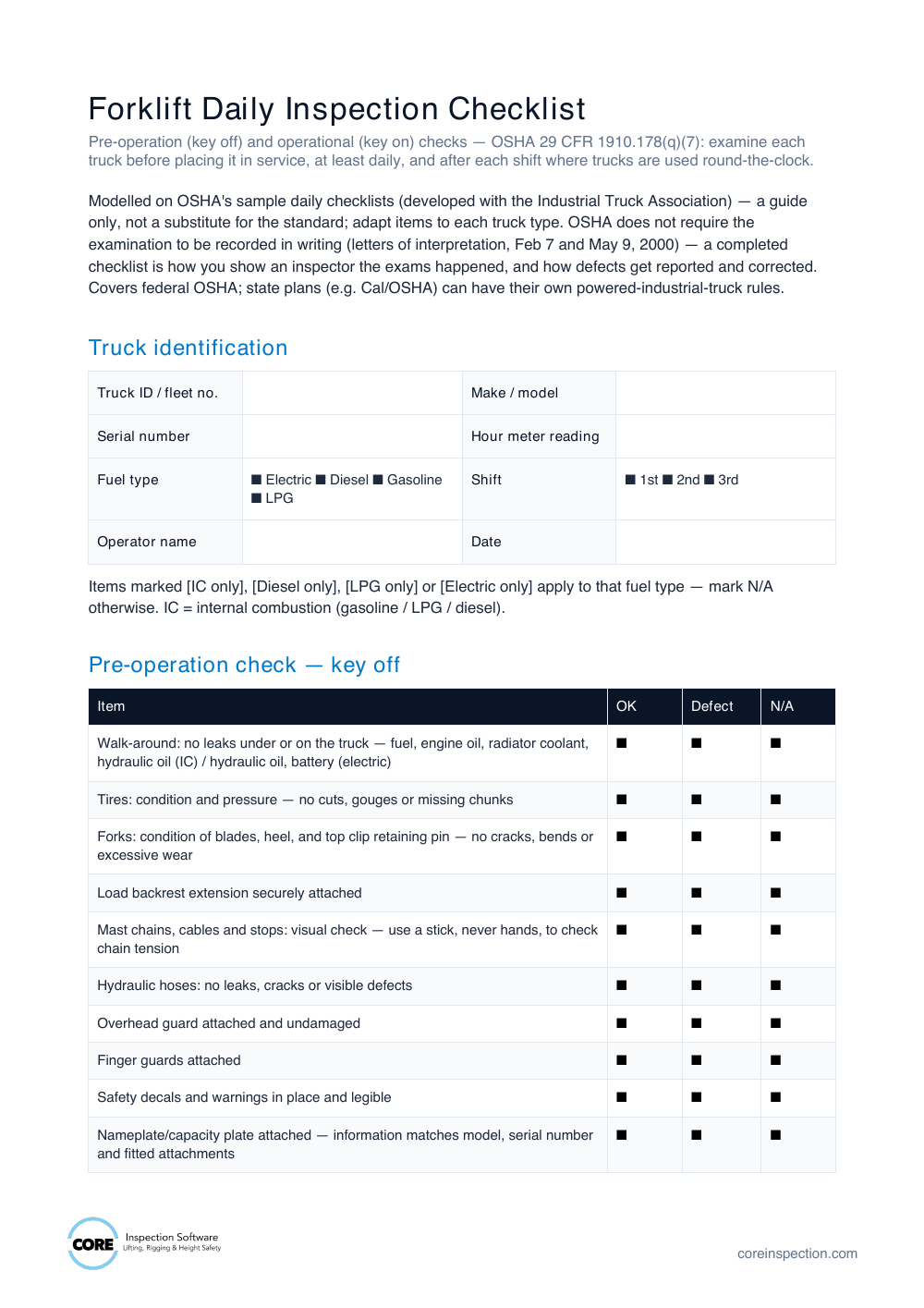
The daily forklift inspection, item by item
The items below are the ones OSHA's Powered Industrial Trucks eTool and OSHA's sample daily checklists walk through, in the order you'd do them. Key off first. Only start the truck once the walk-around is clean.
Walk-around, key offEvery truck
- No leaks under or on the truck: fuel, engine oil, coolant, hydraulic oil, battery
- Tires: condition and pressure, no cuts, gouges or missing chunks
- Forks: blades, heel and top clip retaining pin free of cracks, bends and excessive wear
- Load backrest extension securely attached
- Mast chains, cables and stops look right. Check chain tension with a stick, never your hands
- Hydraulic hoses: no leaks, cracks or visible damage
- Overhead guard attached and undamaged, finger guards in place
- Safety decals and warnings in place and legible
- Nameplate and capacity plate attached and matching the model, serial number and fitted attachments
- Operator's manual on the truck and legible
- Operator compartment clear of grease and debris
- Seat belt or operator restraint present and working. On man-up trucks, fall protection in place
- Hood latch adjusted and securely fastened
- Hydraulic fluid and brake fluid at the correct level
Key off, electric trucksElectric
- Battery water or electrolyte level and state of charge, with face shield, rubber apron and rubber gloves on
- Battery restraint adjusted and fastened
- Cables and connectors: no frayed or exposed wires
Key off, internal combustion trucksGasoline and diesel
- Engine oil and transmission fluid: dipstick check
- Radiator coolant level
- Belts and hoses: visual check
- Engine air cleaner: squeeze the dirt trap or check the restriction alarm
- Diesel: fuel sedimentor checked
Key off, LPG trucksLPG
- Tank mounted within the truck profile, restraint brackets secure, no rust, dents or cracks
- Pressure relief valve pointing up
- Hose and connectors free of leaks, with face shield, long sleeves and gauntlet gloves on
Operational check, key onEvery truck
- Accelerator or direction control pedal works smoothly
- Service brake works smoothly. Inch control works, if fitted
- Parking brake holds the truck
- Steering operates smoothly
- Drive control: forward and reverse engage correctly
- Tilt control: forward and back work smoothly
- Hoist and lowering controls work smoothly
- Attachment control works, if fitted
- Horn works
- Lights and back-up alarm work, if fitted
- Gauges and instruments work: hour meter, plus oil pressure, fuel, temperature and ammeter on IC trucks, battery discharge indicator on electrics
- IC trucks: cab heater, defroster and wipers work, if fitted
- No unusual noises or vibrations
Sign-offEvery shift
- Truck ID, hour meter reading, fuel type and shift recorded
- Fluids, fuel or water added noted
- Operator name, signature and date
- Any defect written up with who it was reported to and when
If anything fails, the truck does not go into service
Report the defect immediately and tag the truck out. It stays out of service until it has been restored to safe operating condition, and the repair is made by authorized personnel. That is three clauses working together: 1910.178(q)(7), (p)(1) and (q)(1). The checklist's defect box and the Excel defect log exist to record exactly that trail.
Who uses this checklist
Anyone who has to show that the 1910.178(q)(7) examination happened, on their own trucks or a customer's fleet.
Forklift operators
The person doing the walk-around each shift. One sheet, key off then key on, nothing skipped.
Warehouse and site supervisors
Collecting completed checklists per truck, per shift: the record an OSHA inspector will ask to see.
Dealers and service companies
Material handling dealers and inspection providers maintaining customer fleets. The defect reports feed your service work.
Safety managers
Standardising the daily examination across mixed fleets: electric, IC and LPG on one form.
What OSHA requires, and what it doesn't
Federal OSHA rules for powered industrial trucks in general industry. State plans such as Cal/OSHA can be stricter, so check your state's rules.
1910.178(q)(7): the daily examination rule
The regulation is short and blunt. Industrial trucks shall be examined before being placed in service, and shall not be placed in service if the examination shows any condition adversely affecting the safety of the vehicle. The examination must happen at least daily, and after each shift where trucks run round-the-clock. Defects, when found, must be immediately reported and corrected.
- Examine before placing in service, at least daily
- Round-the-clock operations: examine after each shift
- Any condition adversely affecting safety means the truck doesn't go into service
- 1910.178(p)(1): a truck found in need of repair, defective, or in any way unsafe comes out of service until restored to safe operating condition
- 1910.178(q)(1): trucks not in safe operating condition are removed from service, and all repairs are made by authorized personnel
OSHA requires the check but not the paperwork
1910.178 does not require the daily examination to be documented. OSHA has confirmed this twice in letters of interpretation (February 7, 2000 and May 9, 2000): no written checklist is required, and record retention is at the employer's discretion. So why fill one in? Because the completed checklist is the only evidence the examination happened. It's what you hand an OSHA inspector after an incident, it's how you make sure every item gets covered on every shift, and it's the defect-report trail (q)(7) needs. OSHA's own eTool says problems should be recorded on a log and reported to a supervisor.
- No OSHA requirement to record the daily examination, confirmed in two interpretation letters
- OSHA notes employers may implement written checklists as a practice beyond the standard
- A signed, dated checklist per truck per shift is how you prove the exams happened
- The defect column creates the reported-and-corrected trail (q)(7) demands
Key off, then key on: how OSHA structures the exam
OSHA's Powered Industrial Trucks eTool splits the daily examination into a pre-operation visual check with the key off, then an operational check with the engine running. Pre-op covers fluids, leaks, hoses and mast chains, tires, forks and the top clip retaining pin, load backrest extension, guards, decals and nameplate, the operator's manual, the operator compartment, and all safety devices including the seat belt, plus extra items by fuel type. The operational check then runs the controls: accelerator, inch control, brakes, steering, drive, tilt, hoist and lowering, attachments, horn, lights, back-up alarm, hour meter, with unusual noises or vibrations reported immediately. OSHA also publishes two sample daily checklists, developed with the Industrial Truck Association: one for internal-combustion trucks, one for electrics. Both carry OSHA's own disclaimer (a guide only, not a substitute for the standard) and so does this one. Every truck type is different: adapt the checklist to yours.
- Pre-operation is visual, key off. Operational is controls, key on
- Fuel-type additions: electric (cables, battery restraints, electrolyte), IC (oil, coolant, belts, air filter), LPG (tank mounting, relief valve pointing up, leak check)
- Never put hands inside the mast. Check chain tension with a stick
- OSHA's sample checklists, and this one, are a guide, not a substitute for the standard
The 1910.178 compliance clocks
The daily examination is the one that recurs every shift, but it sits alongside the operator-training clocks in paragraph (l).
| Requirement | When | Rule |
|---|---|---|
| Daily examination | Before placed in service, at least daily | 1910.178(q)(7): not placed in service if any condition adversely affects safety |
| Round-the-clock operations | After each shift | 1910.178(q)(7) |
| Defect found | Immediately | Report and correct per (q)(7); out of service until restored per (p)(1); repairs by authorized personnel per (q)(1) |
| Operator evaluation | At least once every 3 years | 1910.178(l)(4)(iii) |
| Refresher training | On any of 5 triggers | 1910.178(l)(4)(ii)(A) to (E): unsafe operation observed, accident or near-miss, evaluation reveals unsafe operation, different truck type, workplace change |
Frequently asked questions
No. 1910.178(q)(7) requires the examination itself, not documentation of it. OSHA confirmed this in a February 7, 2000 letter of interpretation (the standard does not require documentation, and record retention is at the employer's discretion) and again on May 9, 2000, noting that no written checklist is required but that employers may implement written checklists as a practice beyond OSHA's requirements. In practice, the completed checklist is how you demonstrate to an inspector that the examinations happened, and it creates the defect-report trail the rule demands: defects, when found, must be immediately reported and corrected.
Related resources
More free templates and resources for inspection professionals.
Guide: OSHA Forklift Inspection Requirements
The full 1910.178 picture: daily exams, training, certification, and defect handling.
View resourceForklift Inspection Software for Dealers
Customer fleet registers, PM scheduling, offline checklists per truck type, and a portal for every customer.
View resourceAll Templates
Every free template and checklist.
View resourceInspecting customer fleets, not just your own?
Core Inspection is built for dealers and service companies that inspect and certify equipment for their customers. Schedule every fleet, capture checks on mobile, turn defects into service work, and give each customer portal access to their own records, unlimited logins included.
Trusted by inspection companies serving 150,000+ organisations worldwide