Rigging Hardware Inspection Checklist (ASME B30.26)
Every check ASME B30.26 sets for shackles, eyebolts, eye nuts, turnbuckles, swivel hoist rings, wire rope clips, wedge sockets, links, rings, swivels and rigging blocks, on this page: markings, the removal criteria every chapter shares, the 10% rule, and the checks by hardware type. The PDF and Word versions add the measurement table, the qualified person's sign-off and a multi-item log for inspecting a whole site's hardware in one visit.
Download Free Rigging Hardware Inspection Checklist
Enter your details below to get instant access.
What's in the downloads
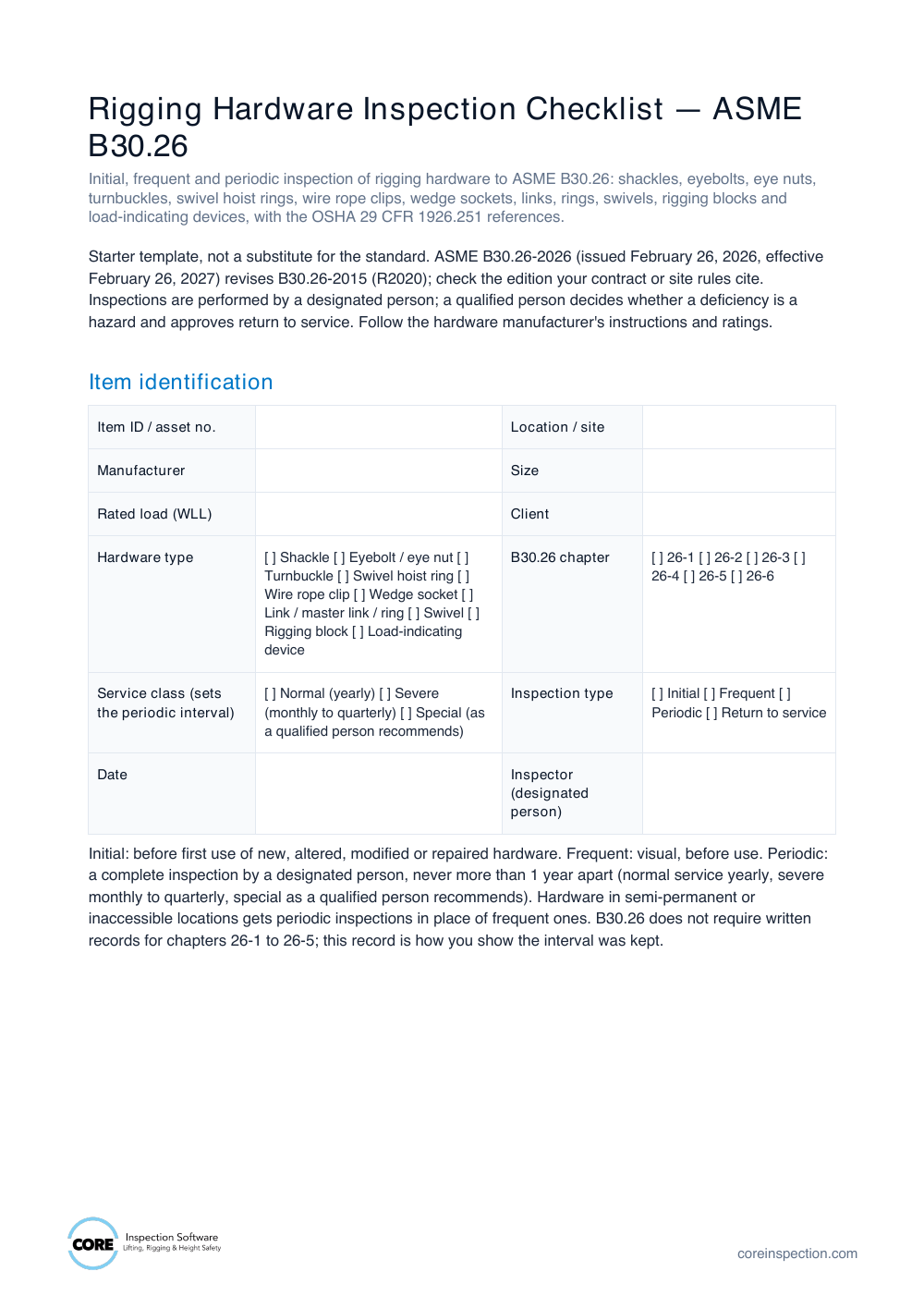
The same checks as the page, laid out as a record a designated person fills in and a qualified person signs, plus a log for inspecting many items on one visit.
- Item identification: ID, site, client, manufacturer, size, rated load, hardware type and B30.26 chapter, the service class that sets the periodic interval, and the inspection type
- Section A, identification and markings, including shackle body and pin marks, alloy eyebolt grade and swivel hoist ring torque value
- Section B, the removal criteria every chapter shares, with the 10% rule
- Section C, checks by hardware type, from pin engagement on shackles to sheave wobble on blocks
- Section D, measurements against the catalog dimension with the percentage reduction
- Section E, deficiencies with the qualified person's hazard decision, then sign-off and return-to-service approval
- Multi-item periodic log: 16 rows for a site visit, with markings, criteria and wear ticks per item
- Standards reference page: ASME B30.26-2026, B30.9, B30.10 and B30.20, 29 CFR 1926.251(a), (c) and (f), 1910.184, 1926.1404 and 1926.1425
- PDF for the clipboard; Word version to add your logo, item IDs and site name
The rigging hardware inspection checklist, item by item
The first two groups apply to every piece of hardware. Then work through the group for the type in front of you. Measure against the manufacturer's catalog dimension, and take anything that fails out of service.
Identification and markingsEvery item
- Manufacturer's name or trademark legible. A country-of-origin stamp alone is not a manufacturer's mark
- Rated load or size legible, as the chapter requires
- Shackles: body marked with name or trademark, rated load and size; pin with name or trademark, and grade, material type or load rating
- Eyebolts: grade marked on alloy eyebolts, and the manufacturer's rating chart to hand if the rated load is not marked
- Swivel hoist rings: rated load and torque value marked
- Markings match the register entry and the item's ID
Removal criteriaEvery item
- No heat damage, including weld spatter or arc strikes
- No excessive pitting or corrosion
- No bent, twisted, distorted, stretched, elongated, cracked or broken load-bearing components
- No excessive nicks or gouges
- No 10% reduction of the original or catalog dimension at any point
- No excessive thread damage or wear, on threaded hardware
- No evidence of unauthorized welding or modification
- No other condition that causes doubt about continued use
Shackles26-1
- Pin fully engaged and seated. Incomplete pin engagement means removal
- No 10% reduction at any point around the body or pin
- Replacement pin meets or exceeds the original manufacturer's specification
Eyebolts, eye nuts and turnbuckles26-2
- Threads clean and undamaged; turnbuckle end fittings undamaged
- Eyebolt suits the load: non-shoulder eyebolts in-line only; shoulder eyebolts for angular loads, shoulder flush and tight, eye in the plane of the pull, load reduced to the manufacturer's table
- Thread engagement at least 1.5 times the bolt diameter in a tapped blind hole in steel; a nut under the load in a thin through-hole
Swivel hoist rings26-2
- Rotates and pivots freely
- Torqued to the manufacturer's value, bushing flange in full contact with the load surface, no spacers or washers under it
- Working load limit covers the sling tension at the rigging angle
Wire rope clips and wedge sockets26-3
- Correct number and spacing of clips for the rope size, from the manufacturer's table or OSHA Table H-2
- U-bolt on the dead end, saddle on the live end, clips tightened to the manufacturer's torque
- No signs of rope slippage, and the wire rope at the termination undamaged
- No unauthorized replacement components, and assembled correctly
- Wedge socket tail at least 6 rope diameters and not less than 6 in, per the manufacturer
- Clips not used to form an eye in a sling (29 CFR 1926.251(c))
Links, master links, rings and swivels26-4
- Swivel rotates freely when unloaded
- No loose or missing nuts, bolts, cotter pins, snap rings or other fasteners and retaining devices
Rigging blocks26-5
- No loose or missing fasteners
- No sheave misalignment or wobble
- No excessive sheave groove corrugation or wear
- Hook on the block inspected to ASME B30.10
Load-indicating devices26-6
- Calibration current to the manufacturer's interval
- Inspected to the manufacturer's instructions
If anything fails, the hardware comes out of service
Tag it out and keep it out of use. A qualified person decides whether the deficiency is a hazard, and the hardware goes back into service only with their approval. Repaired or modified hardware gets an initial inspection before it is used again. On construction sites, 29 CFR 1926.251(a)(1) also requires defective rigging equipment to be removed from service.
Who uses this checklist
Anyone who has to show that rigging hardware was inspected at the right interval, and that what was found was dealt with by the right person.
Rigging inspection companies
Periodic inspections across a client's whole stock of shackles, eyebolts and links, one row per item on the log, with failures written up on the record.
Construction contractors
1926.251(a)(1) requires rigging equipment to be inspected before use on each shift. The checklist covers what to look for.
Plant maintenance and rigging lofts
Initial inspection of new and repaired hardware before it goes into the loft, and the periodic inspection by service class.
Riggers and crane crews
The frequent, before-use visual check, with the removal criteria in front of them.
What ASME B30.26 asks for
ASME B30.26-2026 was issued on February 26, 2026 and takes effect on February 26, 2027. It revises B30.26-2015 (R2020) with the same chapter structure.
Three inspections
An initial inspection by a designated person before first use of new, altered, modified or repaired hardware. A frequent visual inspection before use. A periodic, complete inspection by a designated person, never more than a year apart. Hardware in semi-permanent or inaccessible locations gets periodic inspections in place of frequent ones.
The 10% rule
Hardware with a 10% reduction of its original or catalog dimension at any point comes out of service. For shackles the rule applies around the body and the pin. Recording the measurement at each periodic inspection shows how fast an item is wearing.
Records
B30.26 does not require written records of initial, frequent or periodic inspections for shackles, adjustable hardware, compression hardware, links, rings and swivels, or rigging blocks. Owners and authorities often do, and a dated periodic record is the only way to show the interval was kept.
Hooks, slings and lifters are separate volumes
Hooks are inspected to ASME B30.10, slings to B30.9 and spreader bars and lifting beams to B30.20, even when they share a lift with B30.26 hardware.
Periodic inspection by service class
The periodic interval never exceeds one year. Frequency of use, severity of service, the nature of the lifts and experience with similar hardware move it shorter.
| Service | Interval | Applies to |
|---|---|---|
| Normal | Yearly | Shackles, adjustable hardware, compression hardware, links, rings, swivels, rigging blocks |
| Severe | Monthly to quarterly | The shorter end for heavier use or harsher conditions |
| Special | As a qualified person recommends | Set and documented by the qualified person |
Frequently asked questions
A visual check before use, and a complete periodic inspection by a designated person at least once a year: yearly in normal service, monthly to quarterly in severe service, and as a qualified person recommends in special service. New, altered, modified or repaired hardware also gets an initial inspection before first use.
Related resources
More free templates and resources for inspection professionals.
Guide: ASME B30.26 Rigging Hardware Inspection
The three inspections, removal criteria chapter by chapter, eyebolt angle rules, records and OSHA 1926.251.
View resourceSling Inspection Log (ASME B30.9)
Frequent and periodic sling inspections with the B30.9 removal criteria and records.
View resourceHook Inspection Sheet (ASME B30.10)
Throat opening, twist and latch checks for the hooks on your blocks and slings.
View resourceCrane and Rigging Inspection Software
How Core runs rigging inspections for service companies.
View resourceInspecting rigging hardware for your customers?
Core puts every shackle, eyebolt and link on the client's register with its interval, batches identical items into one inspection, and gives each client their own portal.
Trusted by inspection companies serving 150,000+ organisations worldwide