Free Below-the-Hook Inspection Record — ASME B30.20
ASME B30.20 puts every lifting beam, spreader bar, C-hook, clamp, vacuum lifter, and lifting magnet on three inspection clocks: the operator's every-lift check, a frequent inspection from daily to monthly by service level, and a documented periodic inspection from quarterly to yearly. This record carries the nameplate check (including the BTH-1 Design Category and Service Class most older beams are missing), the frequent and periodic items, measurement rows for straightness, pin wear, and hook throat, the deficiency disposition a qualified person signs, and the load test report with the 125% ceiling and 80% rating rule built in.
Download Free Below-the-Hook Inspection Record
Enter your details below to get instant access.
What's on the record
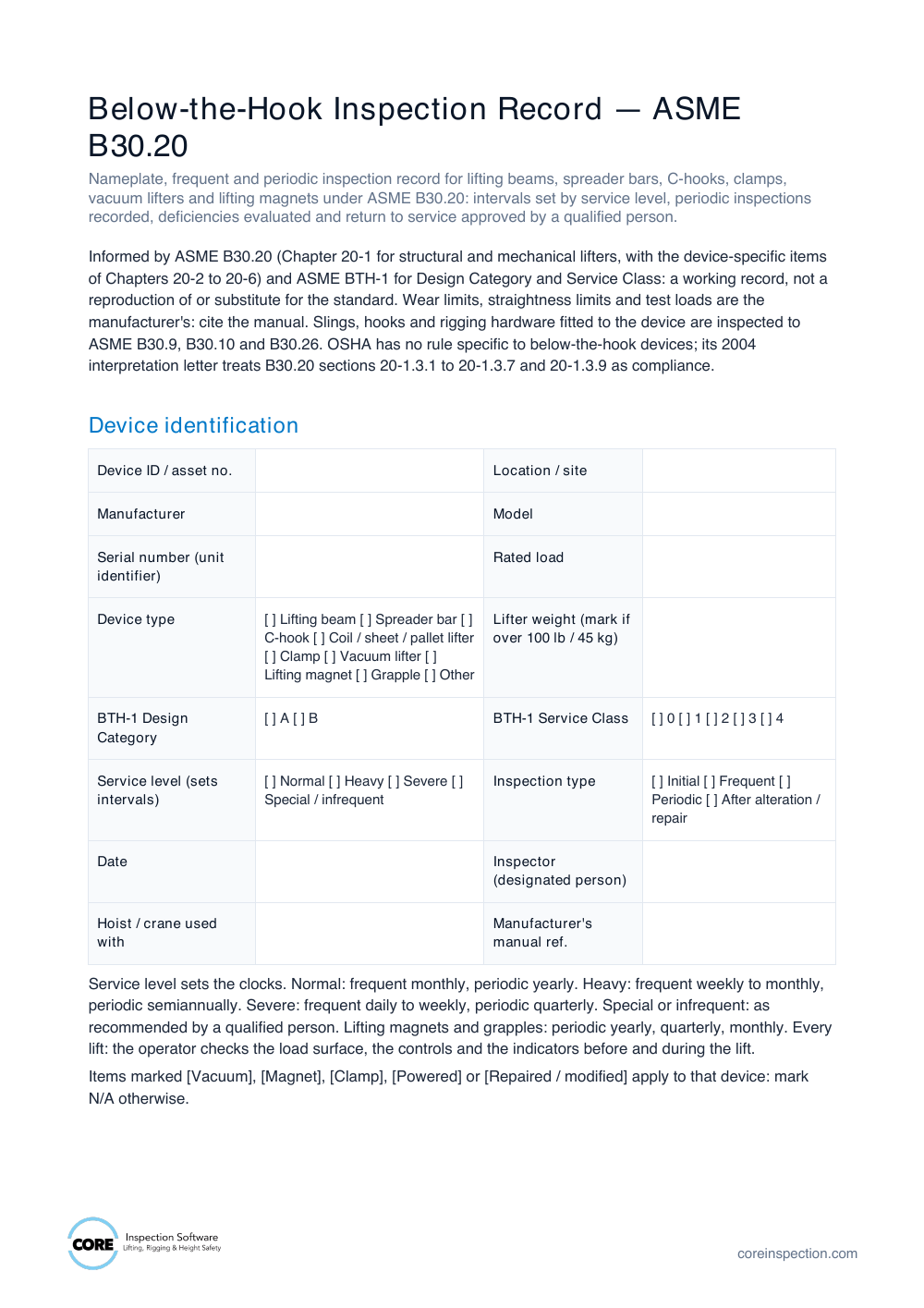
Structured the way B30.20's Chapter 20-1 is structured: marking first, then the frequent items, then the periodic items that go into the device, then the measurements, the disposition of anything found, and the load test.
- Device identification: asset ID, site, manufacturer, model, serial, device type (lifting beam, spreader bar, C-hook, coil or sheet or pallet lifter, clamp, vacuum lifter, lifting magnet, grapple), rated load, lifter weight, BTH-1 Design Category and Service Class, the service level that sets the intervals, and the inspection type
- Section A, nameplate and markings: the eight items B30.20 requires on a structural or mechanical lifter, plus the vacuum, magnet, and repaired-device additions and the product safety labels
- Section B, frequent inspection: structural members for deformation, cracks, and wear; guards, fasteners, covers, stops, and nameplates; operating and hold-and-release mechanisms; control markings; hooking points and pins; the vacuum, magnet, and clamp items
- Section C, periodic inspection: loose bolts; cracked or worn gears, pulleys, sheaves, sprockets, bearings, chains, and belts; friction pads and linkages; wear at hoist hooking points and load support clevises or pins; safety labels; welds, straightness, pin and hole wear, hooks to B30.10
- Section D, measurements: beam straightness and camber, pin diameter, hole elongation, hook throat opening, section loss, NDT of hooking points, vacuum level, magnet breakaway force
- Section E, deficiencies and disposition: hazard determination by a qualified person, removed-from-service tag, repair and retest
- Section F, load test record: reason, who directed it, test load as a percentage of rated load (not more than 125%), method, maximum load sustained, the 80% rating check, post-test visual, report reference
- Sign-off: designated person, qualified person's return-to-service approval, next frequent and periodic due dates, external code mark in lieu of record
- Standards reference page: ASME B30.20-2025, BTH-1-2023, B30.9/B30.10/B30.26, 29 CFR 1926.251, the OSHA letters of 1998, 2002, and 2004, OSH Act 5(a)(1), 1910.179(k) for crane-based tests, AS 4991 for Australia
- PDF for the clipboard; Word version to add your logo, asset IDs, and site name
Who uses this record
Anyone who has to show that a lifter's periodic inspection happened at the right interval, that the nameplate says what B30.20 requires, and that what was found was dealt with by the right person.
Rigging inspection companies and test houses
One record per device, same structure for a 2-ton spreader bar and a 40-ton coil C-hook, with the measurements captured for the trend.
Plant and mill maintenance teams
Running the frequent inspections in-house between the inspection company's periodic visits, and proving they happened.
Construction contractors
1926.251 says rigging equipment is inspected before use on each shift and custom accessories are proof-tested to 125%. This record holds both.
Safety managers and insurers
A nameplate audit across every lifter on site, and a periodic record B30.20 and an OSHA inspector will recognise.
What ASME B30.20 actually requires
The current edition is B30.20-2025, revising 2021, with ASME BTH-1-2023 as its design companion. Chapter 20-1 covers structural and mechanical lifters; 20-2 to 20-6 cover vacuum lifters, lifting magnets, grapples, and clamps with the same five-section structure.
Three inspection clocks, set by service level
The operator checks the device before and during every lift: the load surface for debris, the controls, the indicators. A frequent inspection by a designated person runs monthly in normal service, weekly to monthly in heavy service, daily to weekly in severe service. A periodic inspection runs yearly, semiannually, or quarterly for structural, mechanical, and vacuum lifters, and yearly, quarterly, or monthly for magnets and grapples. Special or infrequent service follows a qualified person's recommendation.
- Normal service: frequent monthly, periodic yearly
- Heavy service: frequent weekly to monthly, periodic semiannually
- Severe service: frequent daily to weekly, periodic quarterly
- Service level describes use and can change; BTH-1 Service Class is a design value in load cycles and stays with the device
The nameplate carries eight items
Manufacturer's name and contact information, serial number, lifter weight if over 100 lb (45 kg), cold current and rated voltage when applicable, rated load, ASME BTH-1 Design Category, and ASME BTH-1 Service Class, with product safety labels required separately. A repaired or modified lifter adds the repairer's name, address, and unit identification and any altered weight or rated load. A lifter with no tag cannot be inspected against anything, and manufacturer guidance is to replace a device with no documentation that cannot be traced to a reputable maker.
- Design Category A: predictable loads, design factor 2.00, Service Class 0 only
- Design Category B: unpredictable or severe, design factor 3.00, any service class; the common case
- Service Class 0 to 4: 20,000 / 100,000 / 500,000 / 2,000,000 / over 2,000,000 design load cycles
- Most lifters are Category B, Service Class 2
Records: periodic yes, frequent no
Dated inspection reports are made on the critical items the periodic inspection covers, and records are available for each periodic inspection and whenever the device is altered or repaired. An external code mark on the lifter is acceptable in lieu of records. The frequent inspection and the every-lift check need no record. B30.20 sets no retention period; the periodic record's value is the trend, so keep it for the life of the device.
- Periodic inspection: dated record required
- Frequent and every-lift: no record required, but log the frequent inspection when you run it for a customer
- Load test: written report confirming the load rating, on file
- Deficiencies: a qualified person decides hazard, repair, disassembly, or a tighter interval, and approves return to service
Load tests: should for lifters, shall for the rest
For structural and mechanical lifters B30.20 says new, altered, or repaired devices should be tested before initial use. If tested, the test runs under the direction of the manufacturer or a qualified person, the test load is not more than 125% of rated load unless the manufacturer recommends otherwise, the rated load may not exceed 80% of the maximum load sustained, and a written report confirms the load rating. Vacuum lifters, magnets, grapples, and clamps use shall. The mandatory 125% proof test most people remember is OSHA 1926.251(a)(4), which applies to custom-designed accessories in construction, not to manufactured beams. The 2025 edition updated the load test method, so check the current text before writing a procedure.
- Chapter 20-1 lifters: recommended; 125% ceiling, no floor
- Rated load not more than 80% of the load sustained
- Vacuum lifters and clamps: required, 125% +5%/−0%
- Crane as test rig: OSHA's 1994 letter under 1910.179(k)
The B30.20 compliance clocks
What recurs, how often, and where the rule sits.
| Requirement | When | Rule |
|---|---|---|
| Initial inspection | Before first use of a new, reinstalled, altered, or repaired device | ASME B30.20, Section 20-1.3 |
| Every-lift inspection | Before and during every lift, by the operator | Load surface, controls, indicators; no record |
| Frequent inspection | Monthly / weekly–monthly / daily–weekly by service level | Visual; designated person; no record required |
| Periodic inspection | Yearly / semiannually / quarterly by service level (magnets and grapples: yearly / quarterly / monthly) | Complete inspection; dated record or external code mark |
| Load test | Should (Chapter 20-1) or shall (20-2 to 20-6) before initial use of a new, altered, or repaired device | Not more than 125% of rated load; rated load ≤ 80% of load sustained; written report |
| Construction shift check | Prior to use on each shift | 29 CFR 1926.251(a)(1) |
Frequently asked questions
The operator checks the device before and during every lift. A frequent inspection runs monthly in normal service, weekly to monthly in heavy service, and daily to weekly in severe service. A periodic inspection runs yearly, semiannually, or quarterly for structural, mechanical, and vacuum lifters, and yearly, quarterly, or monthly for lifting magnets and grapples. Special or infrequent service follows a qualified person's recommendation, and new, altered, or repaired devices get an initial inspection before first use.
Related resources
More free templates and resources for inspection professionals.
Guide: ASME B30.20 Below-the-Hook Inspection Requirements
Intervals, marking, records, the should-versus-shall load test, and what OSHA has said in writing.
View resourceCrane Hook Inspection Sheet (ASME B30.10)
The measurement rows for the hooks on a lifting beam.
View resourceAS 4991 Lifting Device Certification
The Australian record: design certification, proof load, periodic inspection.
View resourceCrane & Rigging Inspection Software (US)
Core for US crane, hoist, and rigging inspection companies.
View resourceInspecting lifters for your customers as well as your own?
Core Inspection is built for companies that inspect and certify lifting equipment for their customers. Keep every lifter's Design Category, Service Class, and service level on the register, run the frequent and periodic clocks per device, attach the load test report and NDT certificates, enforce who can approve a return to service, and give each customer portal access to their own lifting device register, unlimited logins included.
Trusted by inspection companies serving 150,000+ organisations worldwide