Free Hoist Inspection Checklist & Log — ASME B30.16
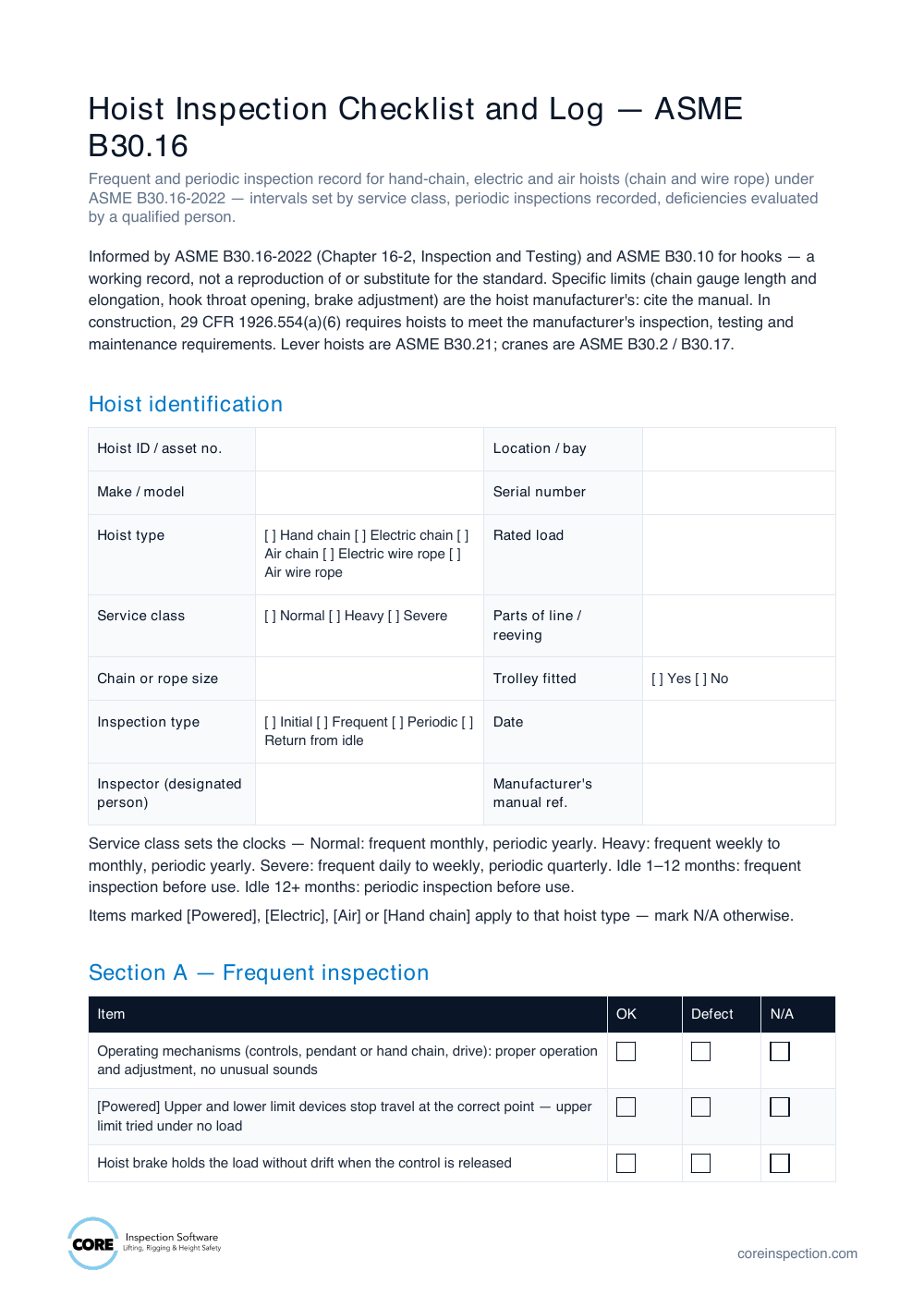
ASME B30.16 puts every hand-chain, electric, and air hoist on two inspection clocks set by service class: a frequent inspection from daily to monthly, and a documented periodic inspection from quarterly to yearly. This checklist carries both — the frequent items on one sheet, the periodic items with measurement rows for hook throat opening, chain gauge length, and rope diameter on the next — plus the defect disposition and sign-off a qualified person needs.
Download Free Hoist Inspection Checklist & Log
Enter your details below to get instant access.
What's on the checklist
Structured the way B30.16's own inspection tables are structured: the frequent inspection items, then the periodic inspection items that go into the hoist, then the measurements and the disposition of anything found.
- Hoist identification: asset ID, location, make/model, serial, hoist type (hand chain, electric chain, air chain, electric or air wire rope), rated load, parts of line, and the service class that sets the intervals
- Inspection type tick-box: initial, frequent, periodic, or return from idle — with the one-month and twelve-month idle rules printed on the sheet
- Frequent inspection: operating mechanisms, upper and lower limit devices, brake holding without drift, hook and latch per B30.10, load chain or rope for gross damage and reeving, air-supply lines on air hoists, labels, and abnormal noise, heat, or leakage
- Periodic inspection: fasteners; load blocks, suspension housings, hand chain wheels, clevises, yokes, shafts, gears, bearings, pins and locking devices; brake friction parts; motor, coupling and gear case; contactors, limit switches and pushbutton stations; trolley and supporting structure; missing components
- Measurement table: hook throat opening and twist against the manufacturer's limit, load chain gauge length over the specified links, wire rope diameter against the 5% rule and B30.16's broken-wire counts, brake drift test, limit device trip points
- Defects found and disposition: hazard determination by a qualified person, removed-from-service tag, repair and retest
- Load test record block: test load as a percentage of rated load (100–125%), load sustained, operations performed, anchorage approval — the written report B30.16 asks for
- Sign-off: designated person, qualified person review, next frequent and next periodic due dates
- Standards reference page: ASME B30.16-2022, B30.10, B30.21, B30.2, B30.17, 29 CFR 1926.554, 1910.179 scope, OSH Act 5(a)(1)
- PDF for the clipboard; Word version to add your logo, asset IDs, and site name
Who uses this checklist
Anyone who has to show that a hoist's frequent and periodic inspections happened at the right interval, and that what was found was dealt with.
Crane & hoist inspection companies
A hoist bay is twenty to a hundred assets on different clocks. One sheet per hoist, same structure every time, measurements captured for the trend.
Plant maintenance teams
Running the frequent inspections in-house between the inspection company's periodic visits — and proving they happened.
Construction contractors
1926.554 says every overhead hoist meets the manufacturer's inspection requirements. The manufacturer wrote them to B30.16; this sheet records them.
Safety managers
Standardising hoist inspection across hand-chain, electric, and air units, and across normal, heavy, and severe service.
What ASME B30.16 actually requires
The current edition is B30.16-2022, issued May 6, 2022. It covers hand-chain, electric, and air hoists, chain and wire rope, overhead underhung or stationary. Lever hoists are B30.21; the cranes a hoist hangs from are B30.2 or B30.17.
Two inspection clocks, set by service class
Frequent inspections are visual and operational checks by the operator or another designated person — monthly in normal service, weekly to monthly in heavy service, daily to weekly in severe service. Periodic inspections are the hands-on examination by a designated person — yearly in normal and heavy service, quarterly in severe service — with dated records. New, altered, or modified hoists get an initial inspection before first use. A hoist idle for one to twelve months gets a frequent inspection before it returns to work; idle a year or more, a periodic inspection.
- Normal service: frequent monthly, periodic yearly
- Heavy service: frequent weekly to monthly, periodic yearly
- Severe service: frequent daily to weekly, periodic quarterly
- Service class is driven by age, repair history, hours, shifts, load spectrum, and environment — record it on the asset
Records: periodic yes, frequent no
B30.16 requires dated records for periodic inspections, which provide the basis for a continuing evaluation of the hoist. It does not require a record of frequent inspections. Most inspection companies log them anyway, because a logged frequent inspection is the only evidence that the layer between periodic inspections existed. Load tests require a written report of the load sustained and the operations performed, placed on file.
- Periodic inspection: dated record required
- Frequent inspection: no record required — log it anyway
- Load test: written report on file
- Deficiencies: examined by a qualified person, who decides what happens before the hoist is used again
The rope rule is not the crane rope rule
B30.2 removes crane rope at twelve randomly distributed broken wires in one lay or four in one strand in one lay. B30.16 counts in rope diameters and is tighter: six randomly distributed broken wires in six rope diameters, or three broken wires in one strand in six rope diameters; for rotation-resistant rope, two in six diameters or four in thirty. Add reduction of more than 5% from nominal diameter, kinking, crushing, birdcaging, core protrusion, corrosion, heat damage, and damaged end connections. Load chain is replaced for elongation beyond the manufacturer's gauge length, wear at the link contact points, gouges, nicks, weld spatter, corrosion, distorted links, or binding in the pocket wheel after cleaning and lubrication.
- Running rope: 6 broken wires in 6 rope diameters, or 3 in one strand in 6 diameters
- Rotation-resistant rope: 2 in 6 diameters or 4 in 30 diameters
- Diameter down more than 5% from nominal: remove
- Chain: the manufacturer's gauge length and elongation limit govern
Load tests at 100% to 125%
New hoists are load tested by the manufacturer at not less than 125% of rated load. Altered, repaired, or modified hoists are load tested when a qualified person determines the work calls for it, at not less than 100% and not more than 125% of rated load unless the manufacturer or a qualified person recommends otherwise; the test can be limited to the functions affected. Replacing load chain or rope is excluded from the load-test requirement, but an operational test is still made before the hoist returns to service. Test anchorages and suspensions are approved by a qualified person.
- New: manufacturer tests at ≥125% of rated load
- Altered, repaired, modified: 100–125%, when a qualified person says so
- Chain or rope replacement: operational test, not a load test
- Written report of load sustained and operations performed
The B30.16 compliance clocks
What recurs, how often, and where the rule sits.
| Requirement | When | Rule |
|---|---|---|
| Initial inspection | Before first use of a new, altered, or modified hoist | ASME B30.16, Section 16-2.1 |
| Frequent inspection | Monthly / weekly–monthly / daily–weekly by service class | Visual and operational; no record required |
| Periodic inspection | Yearly / yearly / quarterly by service class | Hands-on; dated record required |
| Idle hoist | Frequent inspection after 1–12 months idle; periodic after 12+ months | Before return to service |
| Load test | New (≥125%); altered, repaired, modified (100–125%) when a qualified person requires | ASME B30.16, Section 16-2.2; written report on file |
| Hook inspection | With each frequent and periodic inspection | ASME B30.10 criteria |
Frequently asked questions
Frequent inspections run monthly in normal service, weekly to monthly in heavy service, and daily to weekly in severe service. Periodic inspections run yearly in normal and heavy service and quarterly in severe service. New, altered, or modified hoists get an initial inspection before first use; a hoist idle for one to twelve months gets a frequent inspection before it returns to work, and after twelve months idle a periodic inspection.
Related resources
More free templates and resources for inspection professionals.
Guide: ASME B30.16 Hoist Inspection Requirements
Intervals, items, records, load tests, and the rope rule that differs from B30.2.
View resourceCrane Hook Inspection Sheet (ASME B30.10)
The measurement rows for hook throat opening and twist.
View resourceCrane Inspection Checklist & Log
Daily, monthly, and annual sheets for the cranes your hoists hang from.
View resourceCrane & Rigging Inspection Software (US)
Core for US crane, hoist, and rigging inspection companies.
View resourceInspecting hoists for customers, not just your own?
Core Inspection is built for companies that inspect and certify lifting equipment for their customers. Track every hoist on its own frequent and periodic clock by service class, enforce who can sign off a deficiency, batch-inspect a whole bay in one visit, and give each customer portal access to their own hoist register and test reports — unlimited logins included.
Trusted by inspection companies serving 150,000+ organisations worldwide